

Teaching guideKeys, scales & intervals
How to teach half steps, whole steps and accidentals
Half steps and whole steps are the measuring units of music theory. Scales, key signatures, and intervals are all built from them, so time spent here pays off in every later unit. Students learn them fastest on the keyboard, where the distance between two notes is something they can see and touch. This guide moves from the keyboard to sharps, flats, naturals, and enharmonic notes, and ends with the spelling rules that make scales come out right.
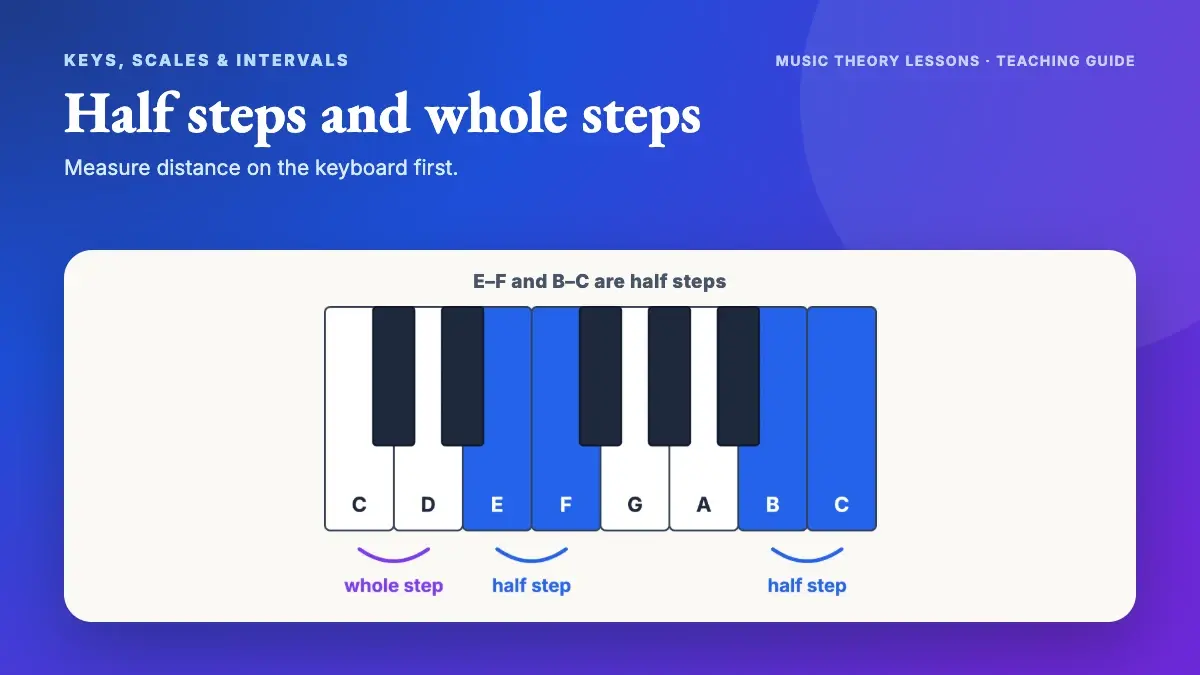
Measure distance on the keyboard
A half step, also called a semitone, is the distance from one key to the very next key, with no key in between. It does not matter whether the keys are black or white. A whole step, also called a whole tone, is two half steps: one key is skipped.
Give every student a real or paper keyboard. Have them start on C and move up by half steps, touching every key, black and white, then start again and move by whole steps, skipping one key each time. Students who count keys with a finger make far fewer mistakes than students who look at a chart.
Use one pair of terms in class and give the other once. North American method books usually say half step and whole step; British and many Canadian books say semitone and tone. The Music Theory Teacher’s Book uses semitone and whole tone and notes that a half step and a semitone are the same thing.
Find the two white-key half steps
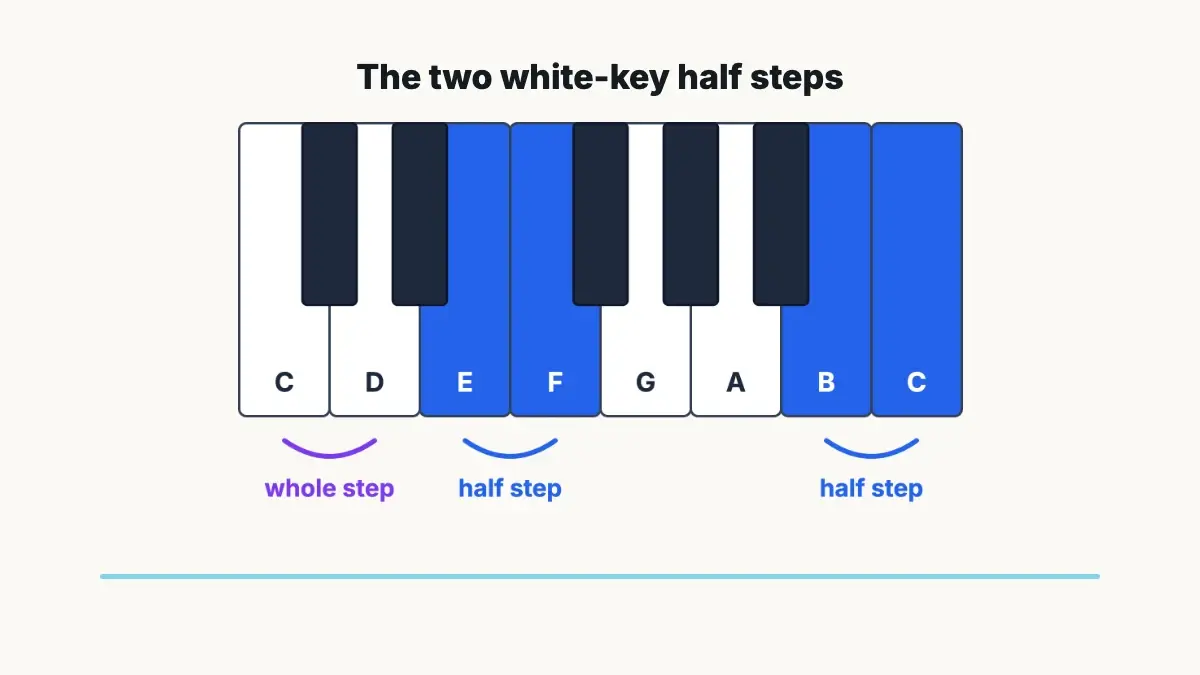
Ask students to find every place where two white keys sit side by side with no black key between them. They will find E–F and B–C. Those pairs are half steps even though both notes are white keys, and they are the reason the major scale has half steps where it does.
Students often assume that every pair of white keys is a whole step. Finding E–F and B–C on the keyboard themselves, rather than being told, makes the exception stick.
Naturals and how long an accidental lasts
A natural sign cancels a sharp or a flat. A natural after a sharp lowers the note by a half step back to its plain letter name, and a natural after a flat raises it by a half step.
An accidental lasts for the rest of the measure and applies to every later note on that same line or space. The bar line cancels it, so the next measure starts fresh unless the note is tied across the bar line. Key signatures are different: they apply to the whole piece until the key signature changes.
Enharmonic notes: one key, two names
Most keys on the keyboard have two names. F♯ and G♭ are the same pitch, and so are C♯ and D♭. Notes that sound the same but are written differently are enharmonic equivalents.
Which name is correct depends on how the note is written on the staff and on the key. A note on the F line with a sharp is F♯, never G♭. Have students write the enharmonic partner of a list of notes, then play both on the keyboard to hear that they are the same sound.
Spell half steps and whole steps correctly
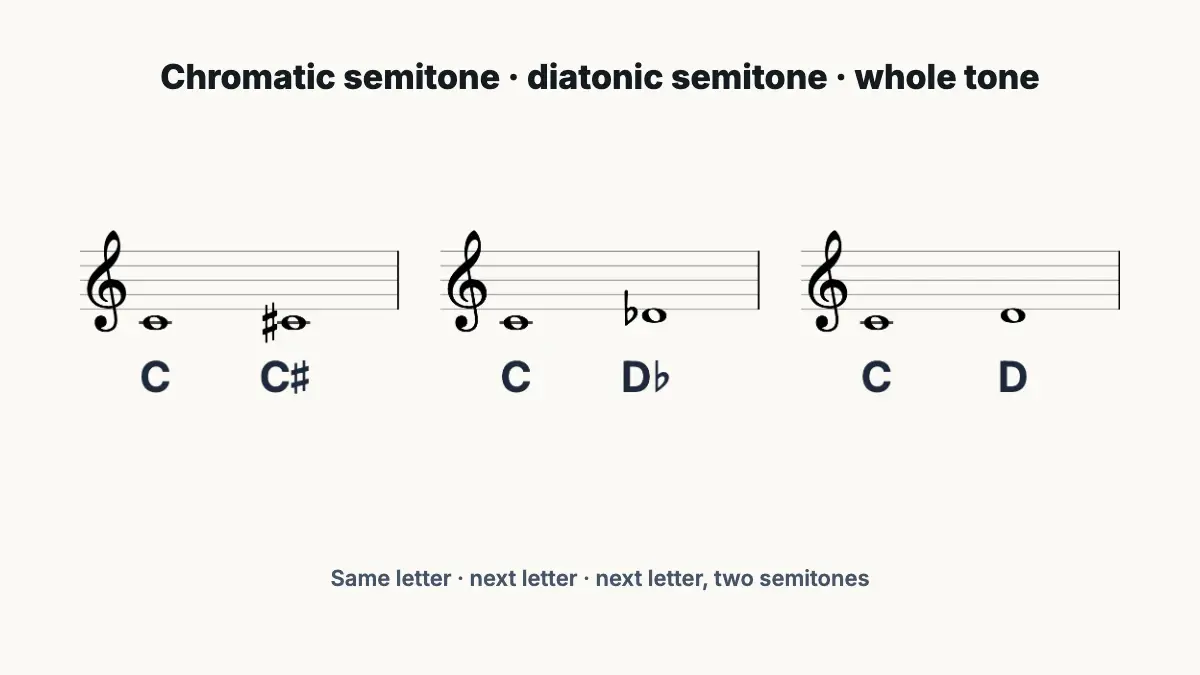
The Music Theory Teacher’s Book separates two kinds of half step. A chromatic semitone keeps the same letter name, such as C to C♯. A diatonic semitone moves to a different letter name, such as C to D♭. The book’s memory aid: D for diatonic, D for different letter.
A whole step always moves to the next letter name: C to D, E to F♯, B♭ to C. That rule is what keeps scale spelling correct. E to G♭ is the same distance as E to F♯, but it skips a letter, so it is not spelled as a whole step.
Have students label pairs of notes as chromatic semitone, diatonic semitone, or whole step. Sorting by spelling as well as by distance prepares them for major scales, where every letter must appear exactly once.
Common mistakes
The most frequent mistakes are calling E–F or B–C a whole step, writing the accidental after the note instead of before it, and forgetting that an accidental carries through the rest of the measure.
Spelling errors come next: writing a whole step as two notes with the same letter, or skipping a letter. Ask students to say the two letter names aloud. If the letters are the same or two apart, the spelling is wrong for a whole step.
A one-week practice plan
Monday: half steps and whole steps on the keyboard, including E–F and B–C. Wednesday: sharps, flats, naturals, and the bar-line rule, with a short note-naming check. Friday: enharmonic notes and the chromatic semitone, diatonic semitone, and whole step sorting task.
Print a fresh semitone and tone worksheet for each check. The Semitones, Whole Tones, and Accidentals chapter of the Music Theory Teacher’s Book covers this sequence on the keyboard and the staff with answer keys, and leads straight into major scales.