

Teaching guideNote reading & notation
How to teach piano key names
The piano keyboard is the clearest picture of how music is organized, which is why so many theory courses begin there. Students who can find any key quickly are ready for note reading, half and whole steps, scales, and chords. The secret is the pattern of black keys: once students can see the groups of two and three, every white key has a fixed address. This lesson plan works with a piano, classroom keyboards, or a printed paper keyboard.
Start with the pattern in the black keys
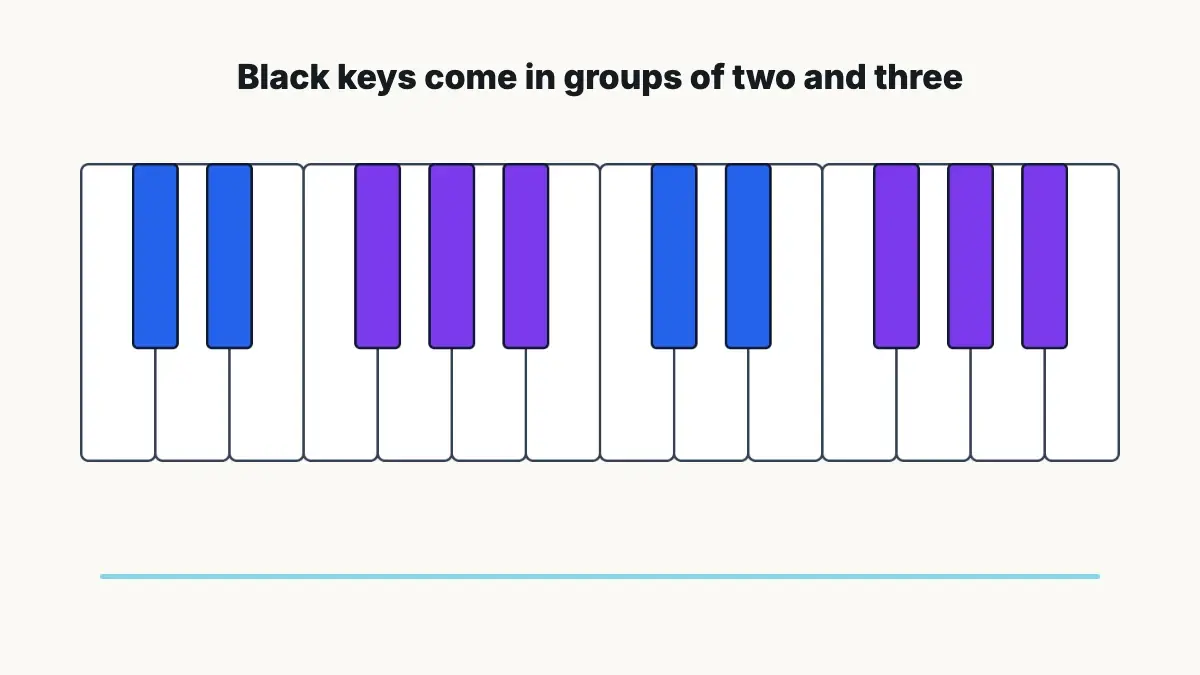
Before naming any keys, ask students what they notice about the black keys. They are not evenly spaced: they come in groups of two and groups of three, and that pattern repeats from one end of the keyboard to the other.
Have students play every group of two black keys with two fingers, from the lowest to the highest, then every group of three with three fingers. Saying “two” and “three” aloud as they play keeps the class together and makes the pattern something they feel as well as see.
Teach the musical alphabet
The white keys use only seven letter names, A to G, and then the letters start again. Going up the keyboard, to the right, the letters move forward: A, B, C, D, E, F, G, A. Going down, to the left, they move backward.
Practice the alphabet away from the keyboard first. Have students say it forward and backward, start from any letter, and answer quick questions such as “What comes after G?” and “What comes before C?” Students who can say the musical alphabet backward without hesitating will find keys much faster.
Use the black keys to find C and F
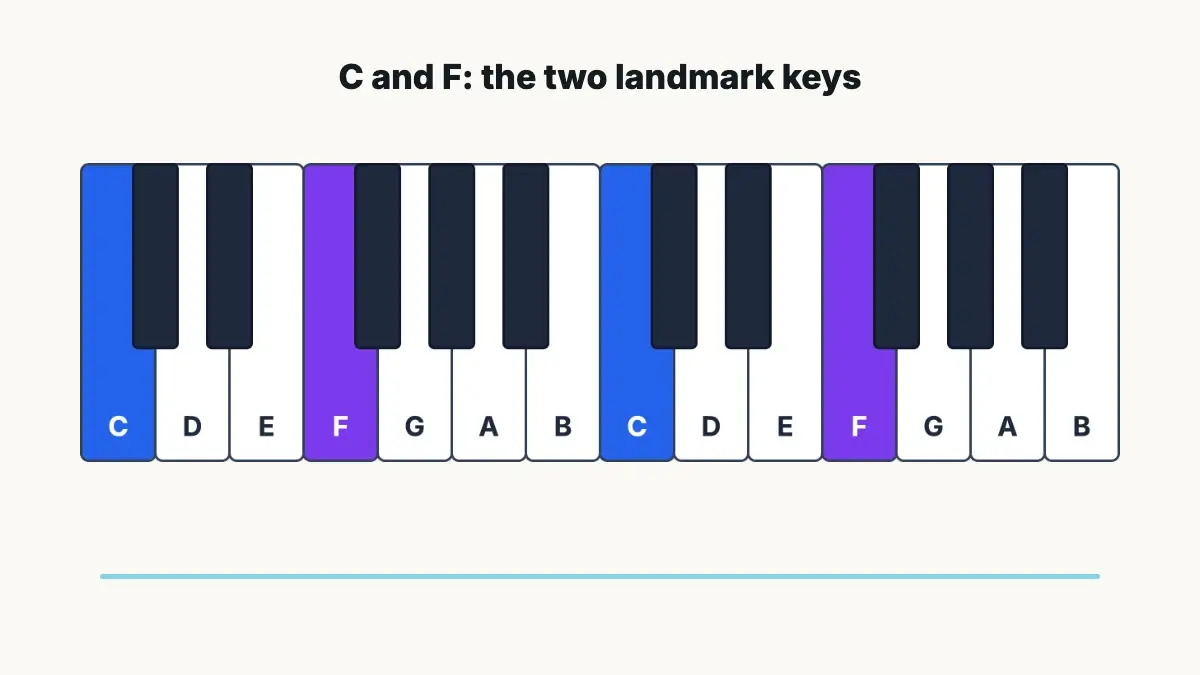
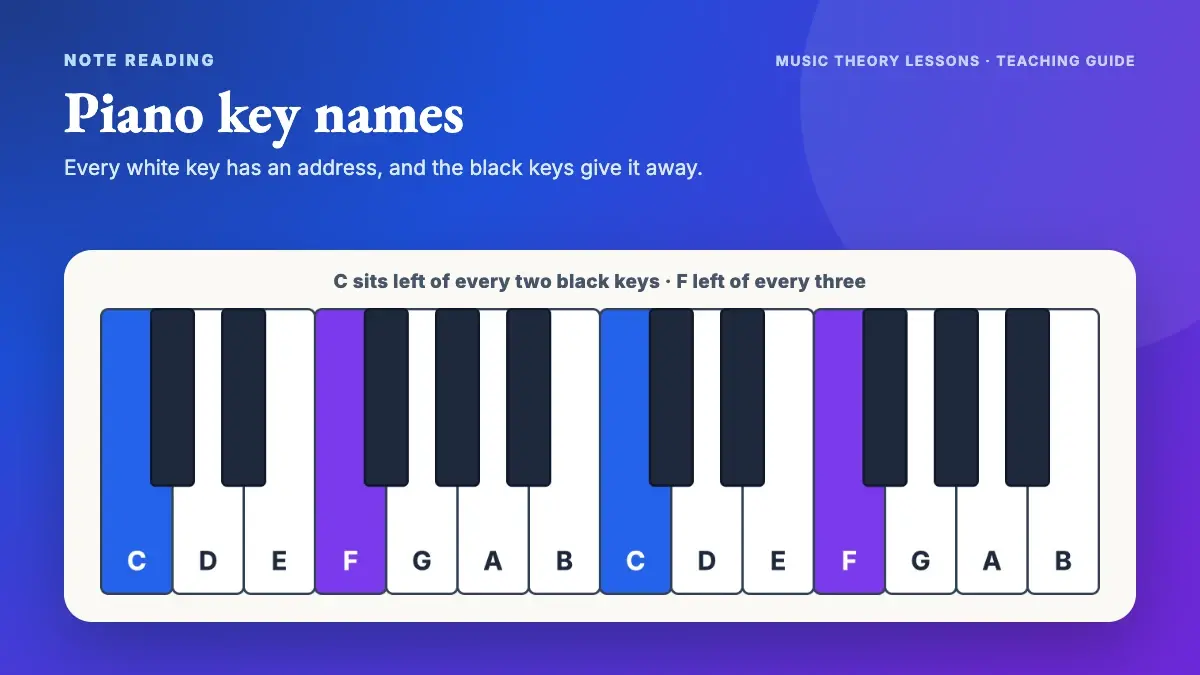
C is the white key just to the left of every group of two black keys. F is the white key just to the left of every group of three. These two landmarks let students find any other white key by stepping up or down the alphabet.
Around the group of two black keys, the white keys are C, D, and E, with D sitting between the two black keys. Around the group of three, the white keys are F, G, A, and B. Have students touch each group and name the white keys around it before moving on.
Make Middle C the home key
Middle C is the C closest to the center of the keyboard, and it is the note that connects the keyboard to the grand staff. Treat it as a home key: students return to it at the start of every activity and find other notes from there.
Show students that the same letter repeats every eight white keys. The distance from one C to the next is an octave, and every C on the keyboard sounds like the same note at a different height. Have them play all the Cs from low to high and listen for the match.
Classroom activities for learning key names
Key races work well for whole classes: call out a letter and have students find every key with that name as quickly as they can. Start with C and F, then add the keys next to them, then any letter.
Without enough instruments, print a paper keyboard for each student and use counters or sticky notes. Students can label keys, cover all the Ds, or build the musical alphabet up and down the keyboard. Laminated keyboards with dry-erase markers let you repeat the activity every lesson.
Finish with a quick reverse check: point to a key and have the class name it, then play it so they hear the sound that goes with the name.
Preview the black key names
Black keys take their names from the white keys beside them. The black key just above C is C sharp, and the same key is D flat because it is just below D. Every black key has two names in this way.
Keep this as a short preview in the first lesson. The full story of sharps, flats, and half steps belongs to its own lesson once students can find every white key without help.
Common mistakes
Students mix up C and F because they look for any black key instead of the right group. Have them name the group, “two” or “three,” before they name the key. Another common mistake is assuming the lowest key on the piano is C. On a full 88-key piano, the lowest key is A and the highest is C.
Some students count up from A every time. That works but is slow, so keep returning to the C and F landmarks until students name keys at a glance.
From the keyboard to the staff
Spend the first lessons on the black-key pattern, the musical alphabet, and the C and F landmarks. Add Middle C and octaves next, then connect each key to a note on the staff. The Piano Keyboard chapter of the Music Theory Teacher’s Book follows this order and then links every staff note to its key.
Use a printable keyboard worksheet as a quick check at the end of each lesson, with a fresh layout each time so students name the keys instead of remembering the page.