

Teaching guideNote reading & notation
How to teach bass clef and ledger lines
Bass clef feels hard to students who learned treble clef first, because the same lines and spaces suddenly carry different letter names. The fix is to teach bass clef from a few reliable landmark notes, connect it to treble clef at Middle C, and then extend both staves outward with ledger lines. This guide gives you that sequence, the mistakes to watch for, and printable practice for each step.
Why bass clef matters for your students
Pianists read bass clef with the left hand, and in band and orchestra it is the home clef for trombone, baritone, tuba, bassoon, cello, and string bass. Choir basses read it too. If any of your students play or sing in that range, bass clef is the clef they will read most, not an extra.
Treat bass clef as a reading skill in its own right rather than a translation of treble clef. Students who convert every note through treble clef read slowly and make the same mistake over and over. The goal is for them to recognize bass clef notes directly.
Start from the F clef and landmark notes
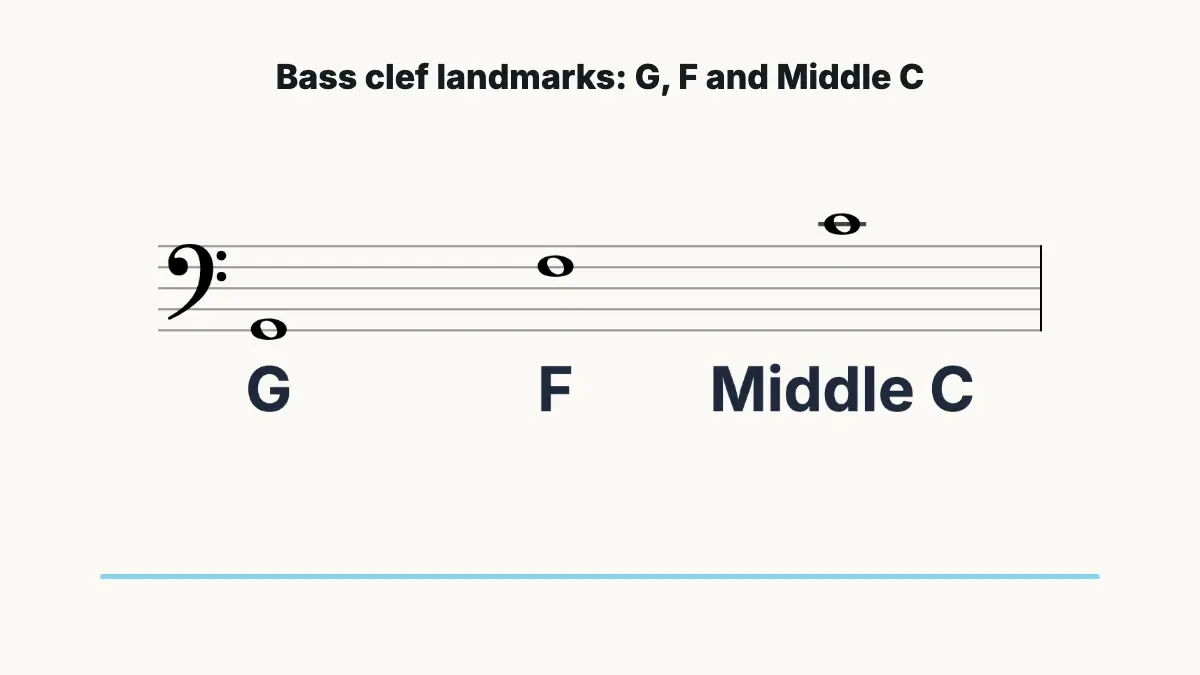
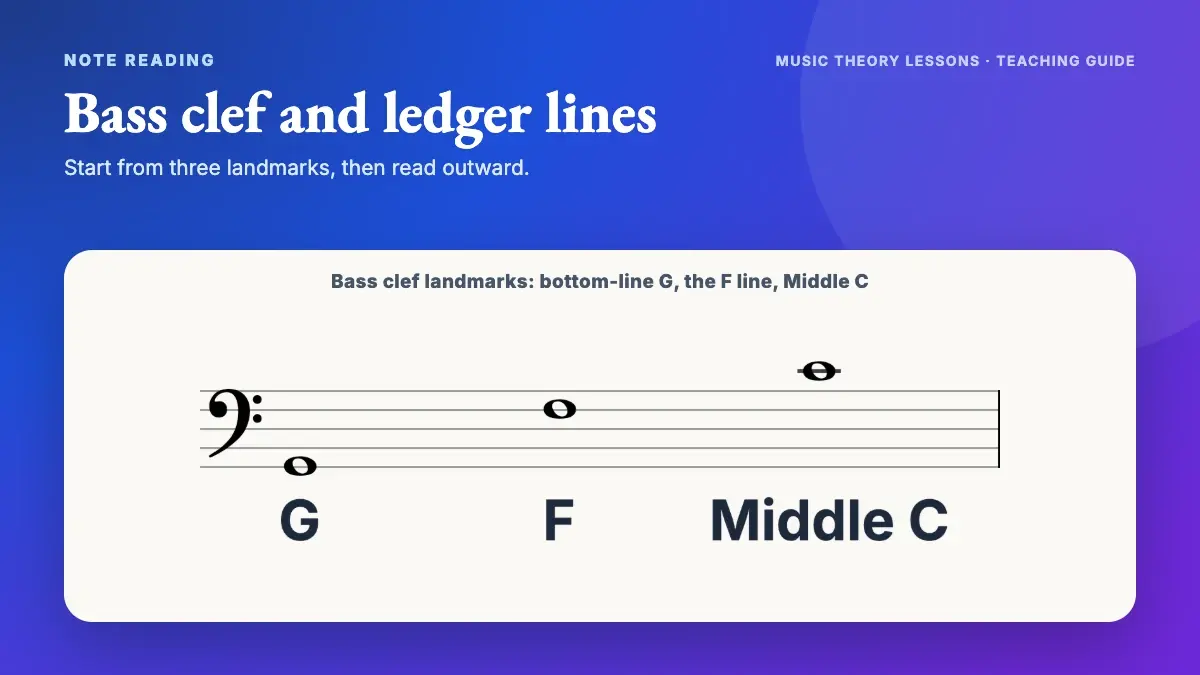
The bass clef is also called the F clef. Its two dots sit on either side of the fourth line, and that line is F, the F just below Middle C. Have students trace the clef and put a finger on the line between the dots. That F is their first landmark.
Add two more landmarks: Middle C, on the first ledger line above the bass staff, and the low G on the bottom line. With three fixed points spread across the staff, students can reach any other note by moving a step or two.
Once landmarks are secure, give students the line and space names. The lines from the bottom up are G, B, D, F, A, and the spaces are A, C, E, G. Familiar memory phrases such as “Good Boys Do Fine Always” for the lines and “All Cows Eat Grass” for the spaces help, but use them as a check, not as the main reading method.
Read by steps and skips
Show students that moving from a line to the next space, or a space to the next line, is a step: the next letter name. Moving from a line to the next line, or a space to the next space, is a skip: one letter name is left out. From the landmark F, the space above is G and the line above is A.
Short drills built on landmarks make this automatic. Point to a landmark, then to a note a step or skip away, and have students name it aloud. Reading by steps and skips is also exactly how students will read melodies, so the skill pays off immediately in their music.
Connect the two clefs at Middle C
The grand staff joins a treble staff and a bass staff with a brace, and Middle C sits exactly between them. It is written on one ledger line below the treble staff or one ledger line above the bass staff, and both positions mean the same key on the piano.
Put a keyboard picture next to the grand staff and mark Middle C in both places. Then walk outward: the B just below Middle C and the D just above it can also be written in either clef. Students who see that the two staves form one continuous ladder of notes stop thinking of bass clef as a separate system.
Have students play or point to each note on the keyboard as they name it. Connecting the written note to a physical key is the clearest proof that they are reading pitch, not just labels.
Extend the staff with ledger lines
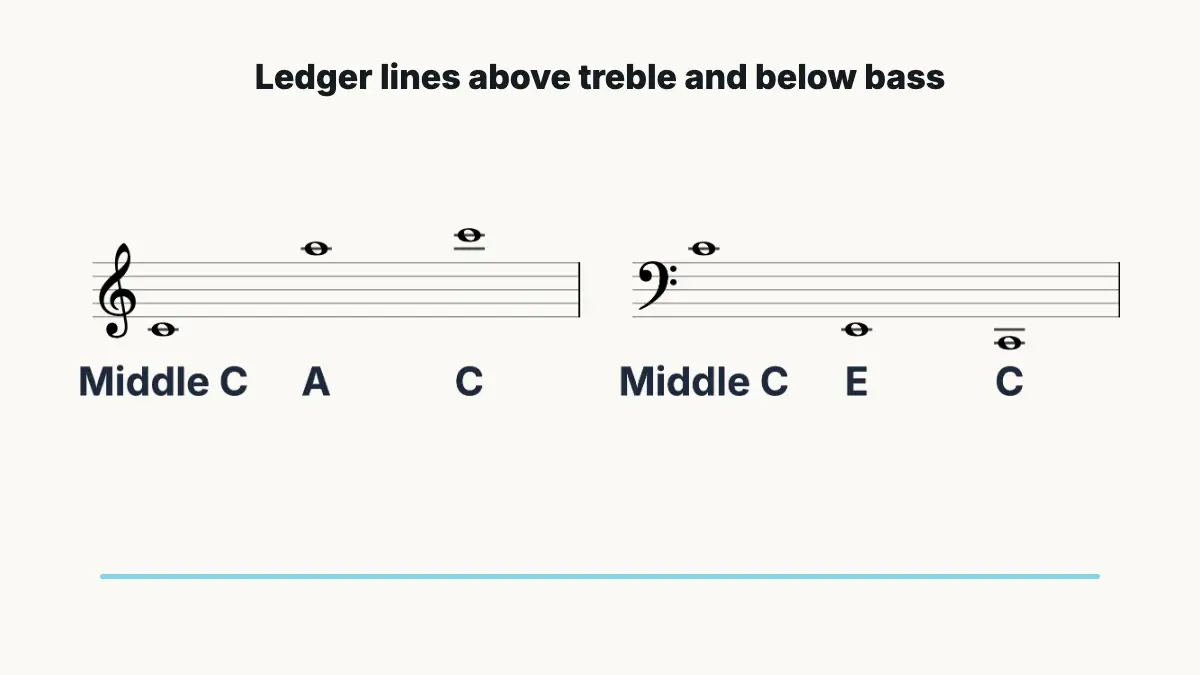
Ledger lines are short lines that extend the staff above or below for notes that do not fit on the five lines. They are spaced exactly like staff lines, so the line-space pattern simply continues. Teach students to count outward from the nearest staff line, saying each line and space name as they go.
In bass clef, the space below the bottom line is F, the first ledger line below is E, and the second ledger line below is C. Above the bass staff, the space is B and the first ledger line is Middle C. In treble clef, the first ledger line above the staff is A and the second is C, while the first ledger line below is Middle C.
Give students the high and low C positions as extra landmarks. Two ledger lines above the treble staff is the C two octaves above Middle C, and two ledger lines below the bass staff is the C two octaves below. From those, any nearby ledger-line note is only a step or two away.
Common bass clef mistakes
The most common mistake is reading bass clef as if it were treble clef. The letter names then come out two letters too low: the bottom line is read as E instead of G. If a student’s answers are consistently off by the same amount, this is almost always the cause, so ask them to find the landmark F before they name anything.
Students also miscount ledger lines, especially when notes are crowded, and confuse Middle C above the bass staff with the C in the second space. Have them count ledger lines with a pencil tip and name the landmark first. Neatly spaced ledger lines in their own writing make reading them easier.
A four-week practice plan
Week 1: the F clef, three landmark notes, and steps and skips. Week 2: all line and space notes in bass clef. Week 3: the grand staff and Middle C, with keyboard work. Week 4: ledger lines above and below both staves.
Print a short worksheet for each week in the range you just taught, and a fresh one for each review so students cannot memorize the answers. Start students who read bass clef in band or orchestra in their own clef, and come back to the grand staff once their home clef is secure.