

Teaching guideKeys, scales & intervals
How to teach major scales
The major scale is the reference point for most of music theory: key signatures, intervals, chords, and cadences are all described from it. Students who understand it as a pattern of whole and half steps, rather than a list of notes to memorize, can build any major scale on their own. This guide shows how to teach that pattern, move it to new keys, spell the result correctly, and name the scale degrees, with printable major scale practice for each step.
Start with a scale students can sing
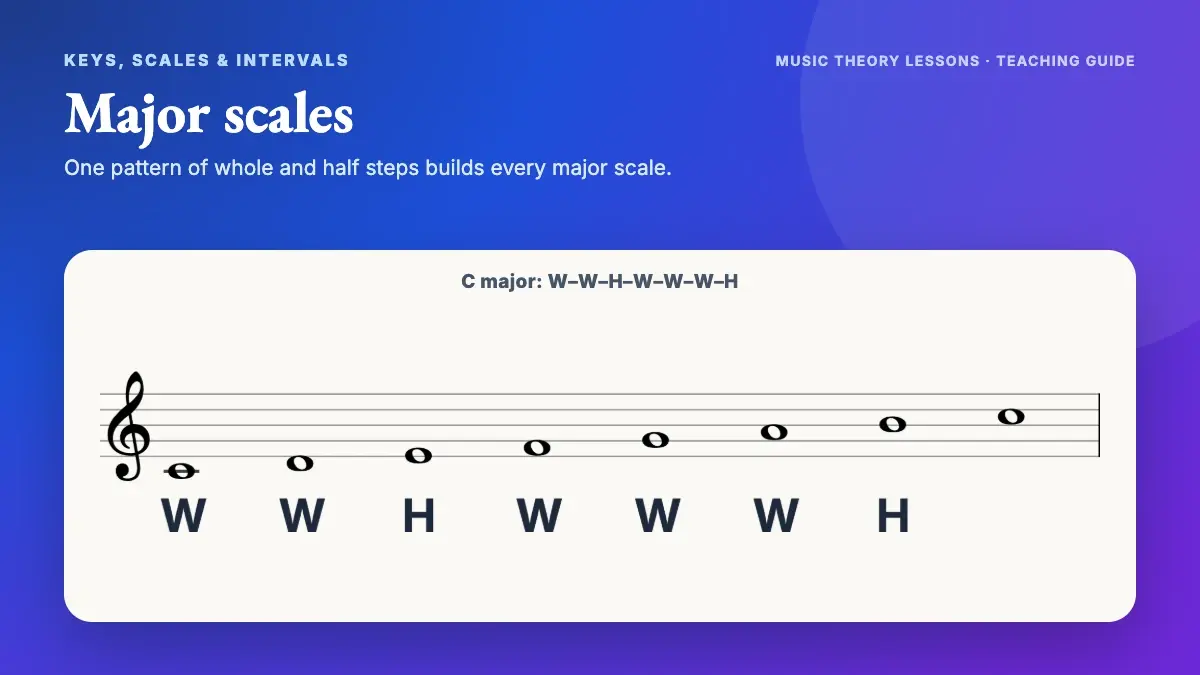
Sing do, re, mi, fa, sol, la, ti, do, then play C major on the white keys from C to C. Students already know the sound of a major scale; the lesson is about explaining why it sounds that way.
Have students sing the scale slowly and listen for the two places where the notes feel closer together: between mi and fa, and between ti and do. They are hearing the half steps before you name them.
Teach the whole and half step pattern
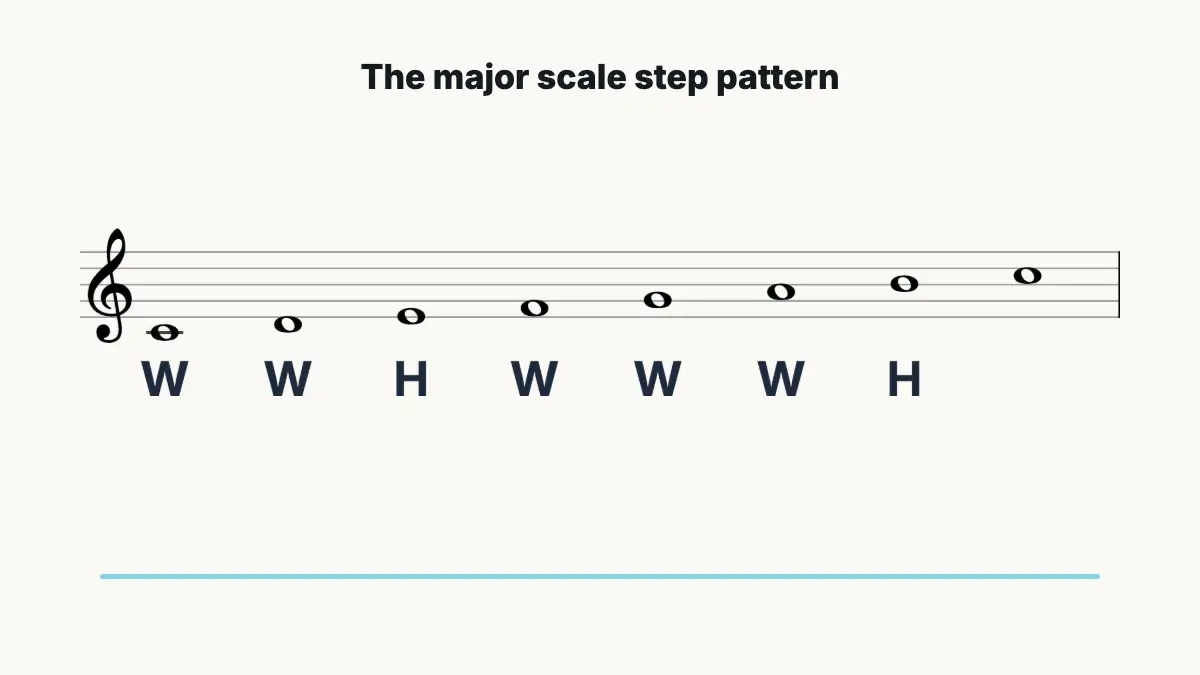
Every major scale follows the same pattern of steps: whole, whole, half, whole, whole, whole, half. Write it as W–W–H–W–W–W–H, and give the British and Canadian version once as T–T–S–T–T–T–S, for tone and semitone.
On the keyboard, have students count the steps in C major. The half steps fall between degrees 3 and 4 (E–F) and between 7 and 8 (B–C), exactly where they heard the notes come closer together. Mark the half steps with a small wedge or slur under the staff every time students write a scale.
Move the pattern to G major and F major
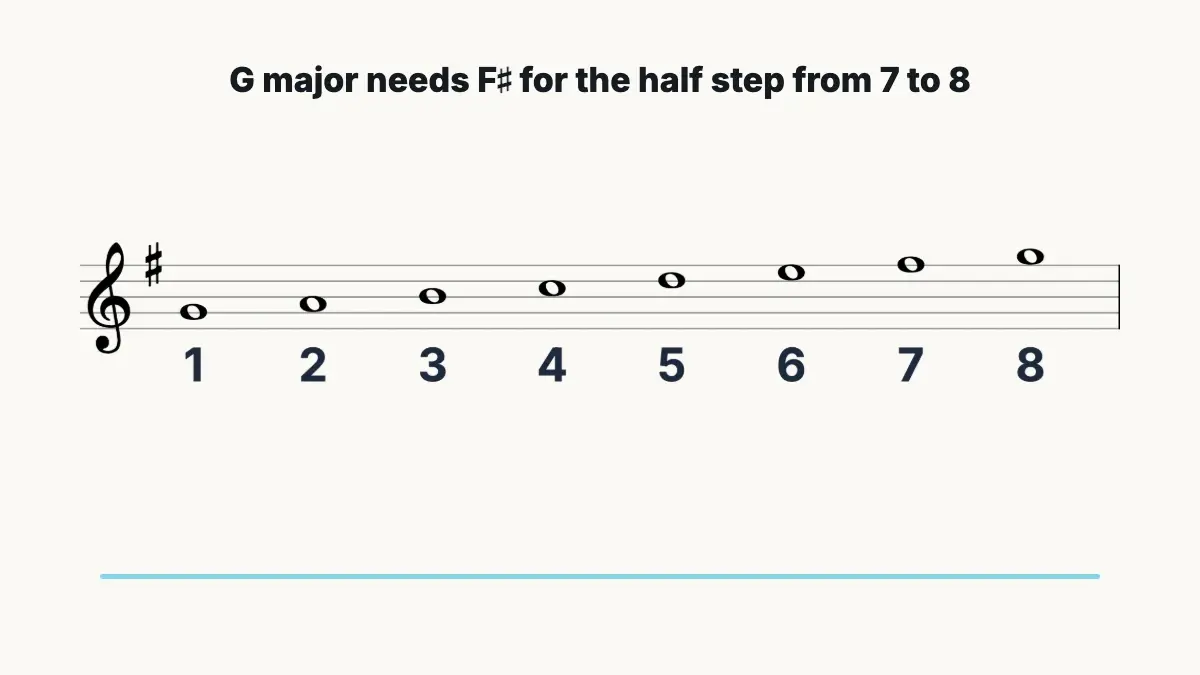
Start a scale on G using only white keys and test each step. Everything matches the pattern until the end: F to G is a whole step, but the pattern needs a half step between degrees 7 and 8. Raising F to F♯ fixes it, so G major is G, A, B, C, D, E, F♯, G.
Then start on F. The step from A to B is a whole step, but degrees 3 and 4 need a half step. Lowering B to B♭ fixes it, so F major is F, G, A, B♭, C, D, E, F.
Students who discover the F♯ and the B♭ themselves understand why key signatures exist. Have them build two or three more scales the same way before showing them any key signature chart.
Spell every major scale correctly
Give students two spelling rules. Every letter name appears exactly once, in order, before the tonic returns. And a major scale uses either sharps or flats, not a mixture of both.
These rules catch most errors. G, A, B, C, D, E, G♭, G has the right sounds, but it skips F and repeats G, so it is spelled wrong. A quick “fix the mistakes” activity, where students circle missing or extra accidentals in scales you have written incorrectly, builds the habit of checking.
Name the scale degrees
Number the degrees 1 to 7 and teach the traditional names: tonic, supertonic, mediant, subdominant, dominant, submediant, and leading tone. These names come back in every later unit, from intervals to chords and cadences.
Ask quick questions in different keys, such as “What is the dominant of G major?” (D) or “Which degree is the leading tone in F major?” (E). Students who can answer in several keys understand the degrees as positions in the pattern, not as fixed notes.
Show the two halves of the scale
A major scale splits into two identical halves of four notes, called tetrachords, each with the pattern whole, whole, half, joined by a whole step. In C major, the halves are C–D–E–F and G–A–B–C.
The upper half of C major is the lower half of G major, and the upper half of G major is the lower half of D major. This chain leads straight to the order of sharp keys and the circle of fifths, so it makes an excellent bridge to key signatures.
Common major scale mistakes
The most common mistakes are skipping or repeating a letter name, mixing sharps and flats in one scale, and placing the half steps in the wrong positions. Having students write the step pattern under every scale and mark the two half steps catches all three.
Students also write accidentals after the note instead of before it, or forget to mark the octave note at the top. Ask them to check every scale against the pattern before handing it in.
A one-week practice plan
Monday: sing the scale, find the half steps, and learn the step pattern on the keyboard. Wednesday: build G major and F major and write two more scales from the pattern. Friday: scale degree names and a mixed major scale worksheet.
Print a fresh set of scales for each check, in treble and bass clef if your students read both. The Major Scales chapter of the Music Theory Teacher’s Book follows the same order, from the step pattern to scale degree names, with answer keys.