

Teaching guideKeys, scales & intervals
How to teach minor scales
Minor scales confuse students when all three forms arrive at once. Taught in order, they make sense: natural minor shares its notes with a major key, harmonic minor changes one note, and melodic minor changes two on the way up only. This guide starts from A minor, the relative minor of C major, and builds each form step by step, with a writing routine students can use for any minor key and printable scale practice with answer keys.
Let students hear major and minor first
Play a short, familiar melody in a major key, then play it again in the parallel minor. Ask students to describe the difference in their own words before you name anything. Most will hear it immediately, and the scale work that follows becomes a way to explain a sound they already know.
Then play a C major scale followed by an A minor scale, both on white keys only. Students can see that the notes are the same and hear that the scale feels different because it starts and ends on a different note.
Teach natural minor through the relative major
A natural minor uses exactly the same notes as C major: A, B, C, D, E, F, G, A. That makes A minor the relative minor of C major. The two keys share a key signature, so students who know their major key signatures already know the signature of every natural minor scale.
Give students two ways to find the relative minor. It starts on the 6th degree of the major scale, or three semitones (a minor 3rd) below the major tonic. G major’s relative minor is E minor, with one sharp, and F major’s is D minor, with one flat.
Contrast relative and parallel minor once the idea is secure. A minor is the relative minor of C major because they share notes. C minor is the parallel minor of C major because they share a tonic.
Show the natural minor pattern
Have students mark the half steps (semitones) in A natural minor. They fall between degrees 2 and 3 (B–C) and between degrees 5 and 6 (E–F). The full pattern of steps is whole, half, whole, whole, half, whole, whole.
Compare it with the major scale, where the half steps fall between 3–4 and 7–8. Students who know where the half steps belong can check any scale they write, which matters more than memorizing a list of scales.
Harmonic minor: raise the 7th
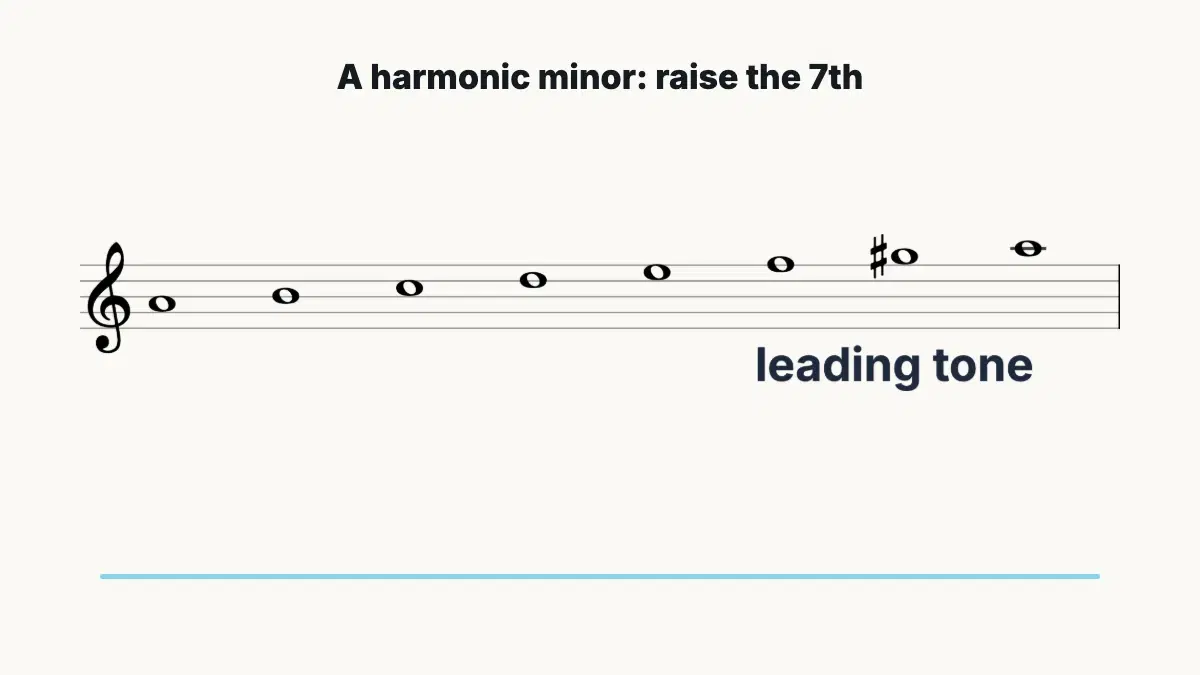
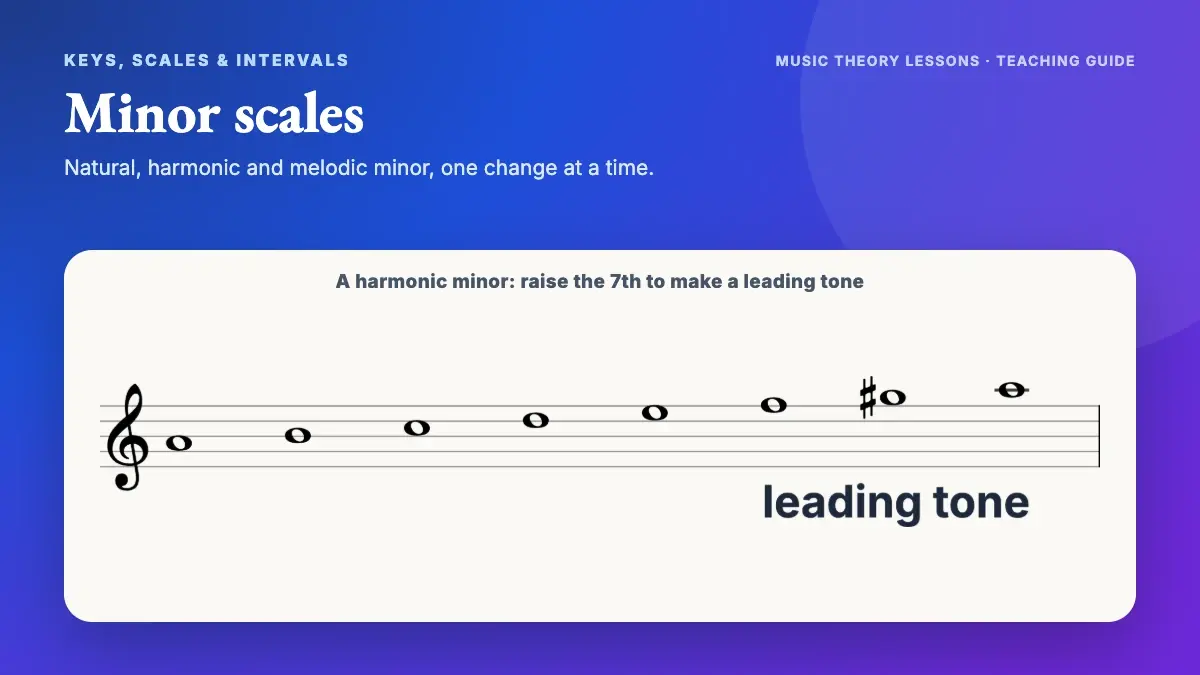
Harmonic minor raises the 7th degree of natural minor by a half step. In A minor, G becomes G♯. The raised note is called the leading tone because it leads strongly up to the tonic, just as the 7th degree does in a major key.
The raised 7th is written as an accidental in the music, never in the key signature. Point out the gap it creates between the 6th and 7th degrees, F to G♯ in A minor. That augmented 2nd gives harmonic minor its distinctive sound, and students usually recognize it once they hear it.
Explain why composers use it: the raised 7th makes the chord on the 5th degree major, E major in A minor, which pulls strongly back to the tonic at cadences.
Melodic minor: different up and down
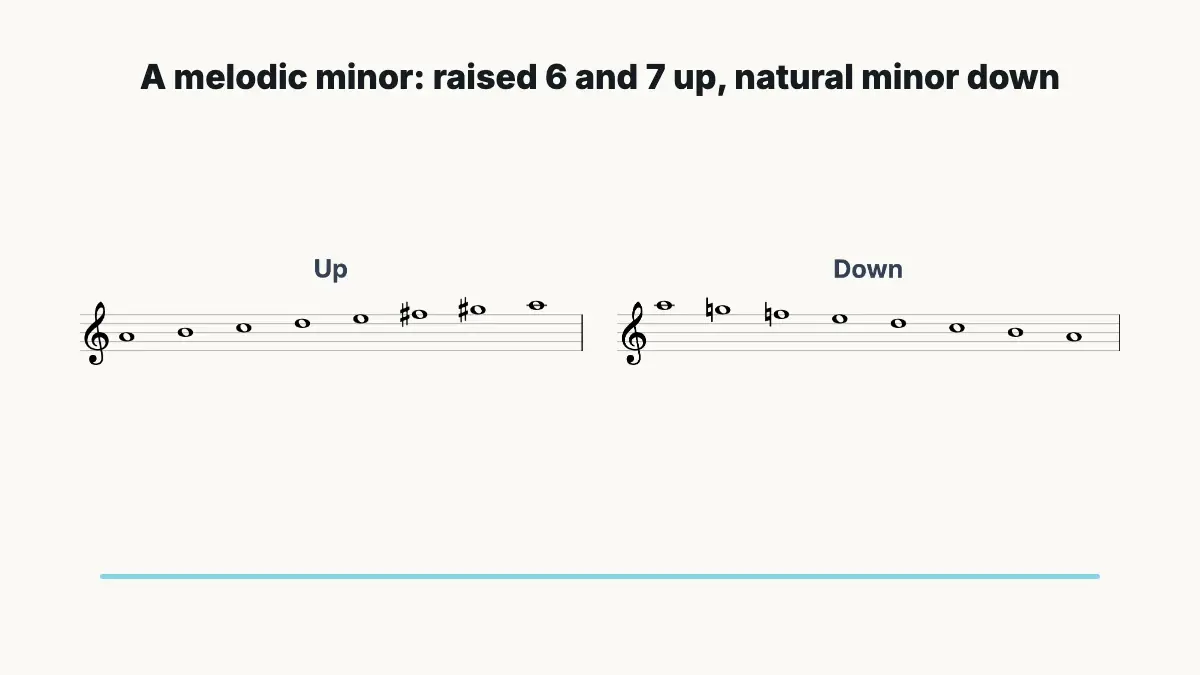
Melodic minor raises both the 6th and the 7th degrees on the way up, and returns to natural minor on the way down. In A minor it rises A, B, C, D, E, F♯, G♯, A and falls A, G, F, E, D, C, B, A.
The reason is melodic. Raising the 7th alone leaves the awkward augmented 2nd between degrees 6 and 7; raising the 6th as well smooths the line on the way up. On the way down there is no need for a leading tone, so the natural minor notes return.
This ascending and descending form is often called the classical melodic minor. In jazz, the melodic minor scale keeps the raised 6th and 7th in both directions, which is worth a short mention for older students.
A writing routine for any minor key
Give students one routine and use it every time. First, find the key signature from the relative major. Second, write the natural minor scale with that signature. Third, add accidentals: raise the 7th for harmonic minor, or raise the 6th and 7th on the way up for melodic minor, cancelling them on the way down.
Work D minor together as an example. The relative major is F major, so the signature has one flat, B♭. Natural minor is D, E, F, G, A, B♭, C, D. Harmonic minor raises C to C♯. Melodic minor rises with B♮ and C♯ and falls with C♮ and B♭.
Common minor scale mistakes
Students often add the raised 7th to the key signature, forget to cancel the raised notes on the way down in melodic minor, or raise the wrong degree. Have them number the scale degrees under every scale they write so the 6th and 7th are easy to find.
Mixing up relative and parallel minor is the other frequent error. If a student says the relative minor of C major is C minor, ask whether the two scales share notes or share a starting note.
A one-week practice plan
Monday: hear major and minor, then natural minor through the relative major. Wednesday: harmonic minor and the leading tone, with a short written scale check. Friday: melodic minor up and down, then a mixed set of all three forms.
Print a fresh set of scales for each check, in both treble and bass clef if your students read both. The Minor Scales chapter of the Music Theory Teacher’s Book follows the same order, from relative keys to all three forms, with answer keys.