

Teaching guideKeys, scales & intervals
Circle of fifths activities for the music classroom
The circle of fifths is easier to remember when students move, sort, and hear keys — not when they stare at a wall poster once a semester. This guide collects classroom activities teachers in our community use to connect signatures, scales, and chord neighbors: human circle games, card sorts, fill-in wheels, and short assessments you can regenerate with fresh examples. Use it alongside key-signature identification worksheets so students see the circle as a map for the music they already play.
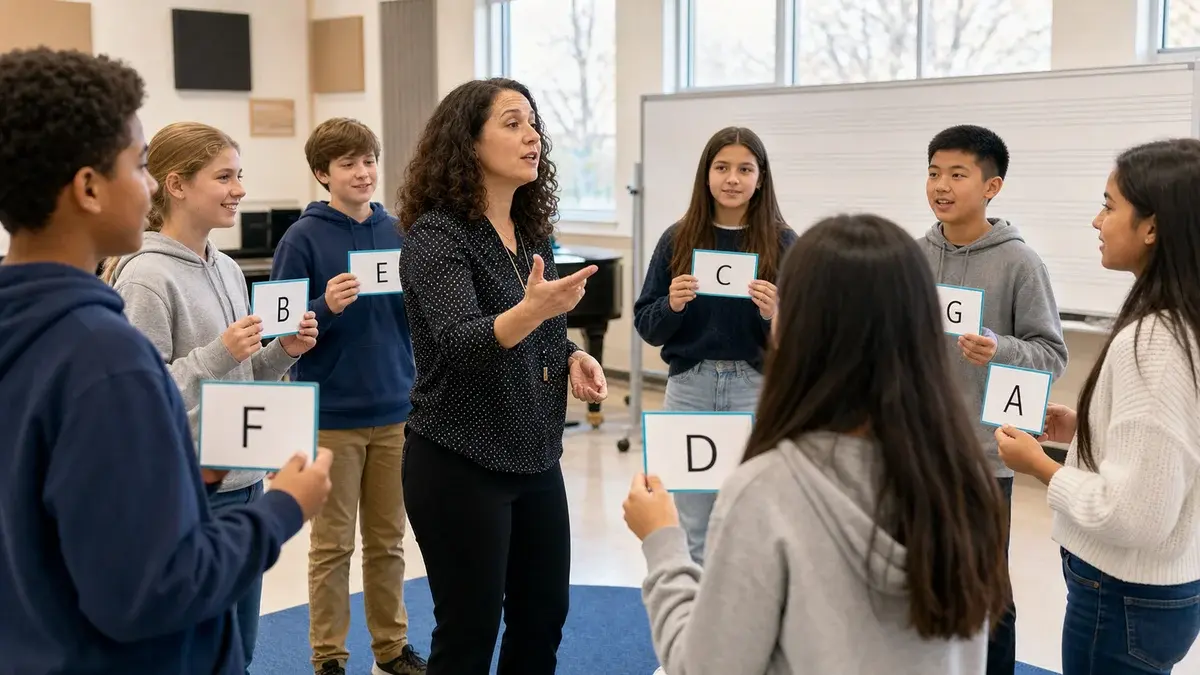
Treat the circle as a map students can walk
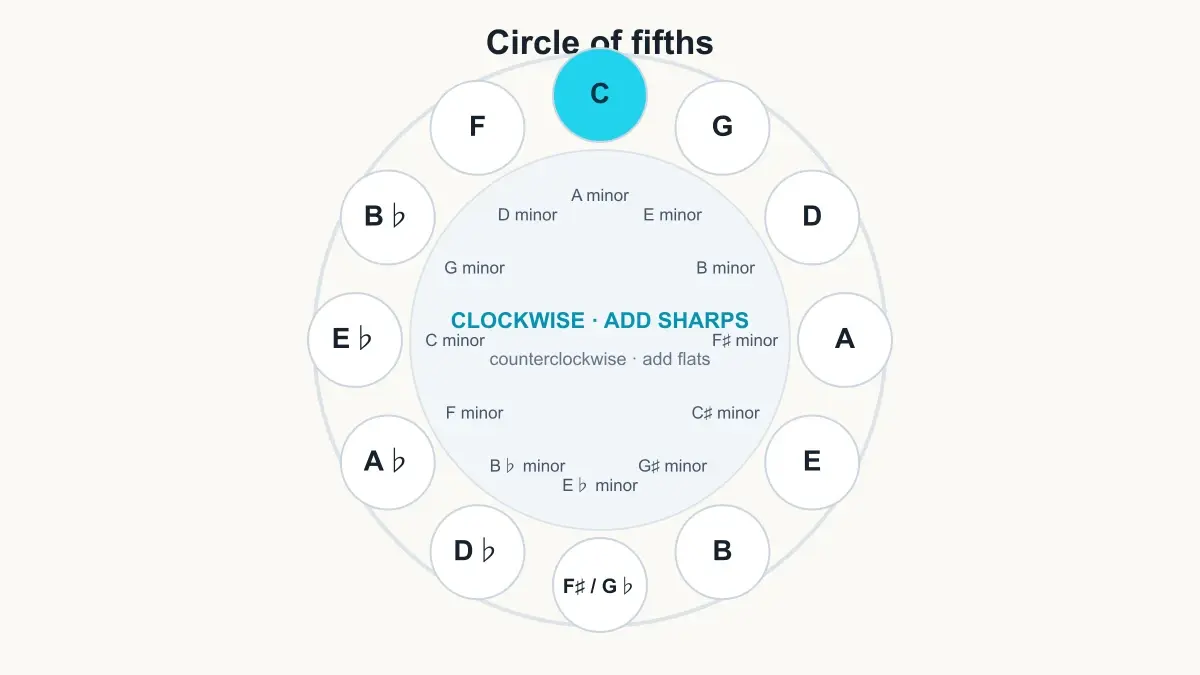
A poster helps visual learners, but retention improves when students place keys themselves. Start with C at the top and ask: “What is one sharp more than C?” Move clockwise for sharps and counterclockwise for flats so direction matches how signatures accumulate.
Limit early work to one quadrant — C, G, D, A or F, B♭, E♭ — before the full wheel. Students who master neighbors in a small set generalize faster than those who copy twelve labels in one sitting.
Link each key on the circle to a piece or exercise students know. G major means something when it is the key of the march they are rehearsing, not only a letter on a diagram.
Human circle and “pass the key” games
Give each student a key card (name, signature, or scale-degree tonic). Stand in circle order clockwise from C. Call “next sharp key” or “back one flat” and have students move or pass cards until the order is correct.
Time the reset: can the class rebuild the sharp side from G to E major in under ninety seconds? Gamifying retrieval beats copying the circle from a textbook.
For large ensembles, assign sections to sharp keys and others to flat keys — each group becomes expert in one side before teaching the full class.
Card sorts for signatures and relative minors
Print cards with key names, key signatures, and relative minor pairs. Students sort into sharp keys, flat keys, or major/minor relatives on desks or the floor.
Mix in one deliberate mismatch (D major / B minor pair with wrong signature) and ask groups to find the error. Error detection forces reading, not color matching.
After sorting, generate a three-key identification worksheet in Worksheet Studio matching the card set — paper practice should mirror the activity students just completed.
Fill-in wheels and blank-circle worksheets
Blank-circle worksheets work as exit tickets: students write key names clockwise from C, add sharps or flats, or label only the keys your concert uses this month.
Younger students can fill every other slot first (C, D, E…) then add sharps later. Older students spell scale tones or Roman numerals around the wheel.
Regenerate a blank template weekly so layout changes — students cannot memorize slot positions on one photocopy.
Connect the circle to scale spelling
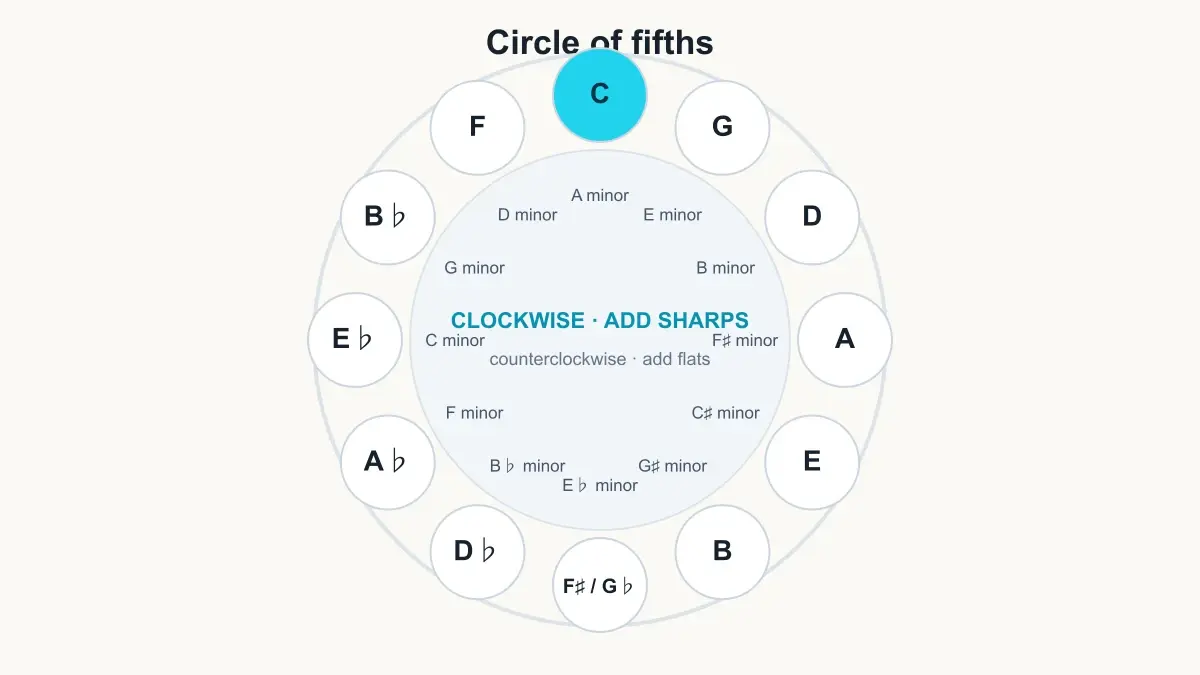
Before students label the full circle, they should spell major scales for keys in your current unit. Each new sharp or flat on the circle is the leading tone or fourth scale degree of the next key — make that relationship explicit on the board.
Use major scale writing worksheets for the same keys on the circle that week. Identification without spelling stays shallow; together they build durable memory.
When students add minor keys, place relative minors inside the major ring so the circle shows two relationships at once — signature family and tonic center.
Neighbor keys and simple progressions
Introduce I–V–I motion in C, then G, then D by moving one step clockwise on the circle. Students hear why “five” chords often come from the key one sharp ahead.
Piano and guitar classes can arpeggiate tonic and dominant triads while the class calls key names around the wheel. Choir classes can sing solfege patterns on do and sol in each key before modulating.
Do not require full harmonic analysis on day one — hearing dominant to tonic in neighboring keys is enough to justify why the circle order matters.
Assess with fresh keys, not one fixed wheel quiz
Rotate assessment format: Monday card sort, Wednesday neighbor-key oral quiz, Friday generated key-signature sheet. Variety measures retrieval, not one memorized diagram.
For concerts, assess only keys in the program plus their neighbors on the circle — practical retrieval beats abstract completeness early in the year.
Wrong answers on relative major/minor pairs signal a lesson gap, not a failed activity. Pair circle work with our key signatures guide when students confuse G major and E minor.
Put it into practice this week
Monday: human circle with C, G, D, F. Wednesday: card sort with signatures. Friday: fill-in wheel exit ticket plus a fresh three-key worksheet.
Assign students to teach one neighbor key to a partner using the circle — teaching cements order better than silent copying.
Post the concert keys on a partial circle near the stand so theory class and rehearsal share the same visual reference.