

Teaching guideKeys, scales & intervals
How to teach musical modes
Modes are often taught as “the major scale starting on a different note,” which leaves students able to recite names but unable to hear the difference. Modes make sense when students first hear how changing the home note changes the sound, then learn a reliable way to build and identify each one. This guide covers both: listening over a drone, the parent-scale method used in the Music Theory Teacher’s Book, and a comparison with major and minor that helps students remember each mode’s character.
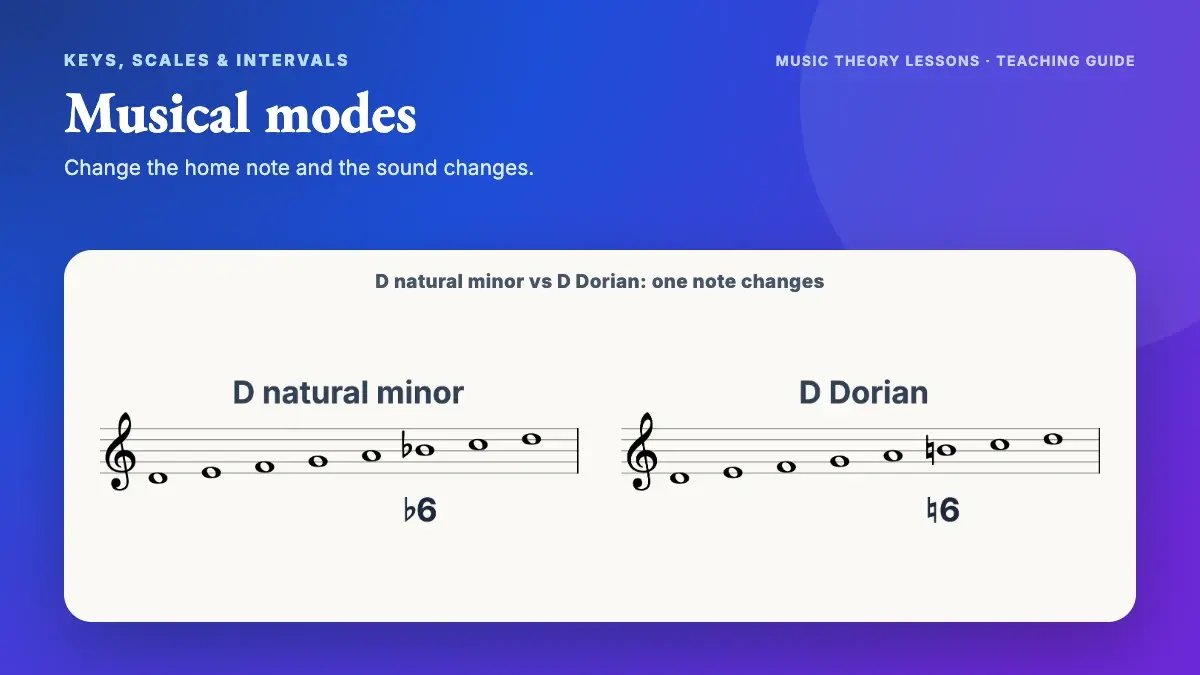
Start by listening over a drone
Hold a steady D on a keyboard, cello, or drone app and play a D natural minor scale over it, then a D Dorian scale. Only one note is different: B♭ in natural minor and B♮ in Dorian. Ask students to describe how the second scale feels. Most say it sounds brighter or more hopeful, while still minor.
A drone matters because a mode is defined by its home note. Played without a clear tonic, the white keys from D to D just sound like C major. Over a D drone, the same notes sound like D Dorian.
Teach the seven names in order
Each mode of the major scale starts on a different degree: Ionian on degree 1, Dorian on 2, Phrygian on 3, Lydian on 4, Mixolydian on 5, Aeolian on 6, and Locrian on 7. On the white keys they start on C, D, E, F, G, A, and B.
A memory sentence helps with the order, such as “I Don’t Particularly Like Modes A Lot.” Point out that two of the modes are already familiar: Ionian is the major scale and Aeolian is the natural minor scale.
Build any mode from its parent major scale
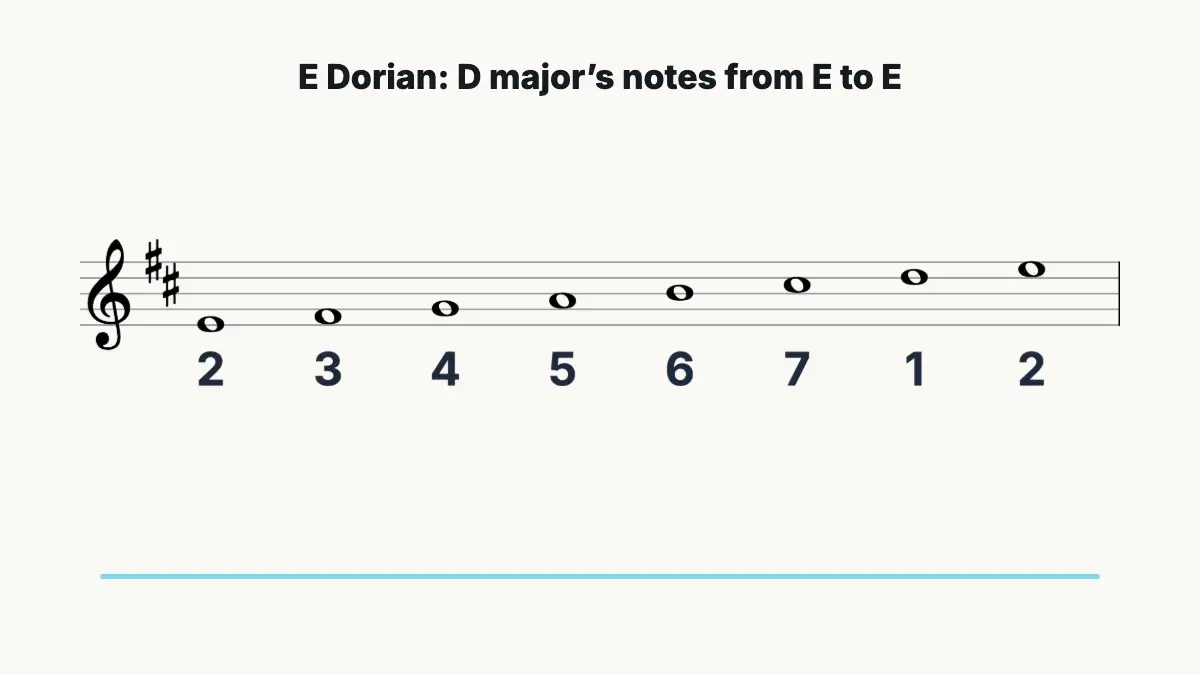
The Music Theory Teacher’s Book uses a three-step routine. Find the parent major scale, keep its key signature, and begin and end on the named tonic. For E Dorian, Dorian starts on degree 2, so E must be degree 2 of the parent scale. That parent is D major, with two sharps, so E Dorian is E, F♯, G, A, B, C♯, D, E.
G Mixolydian starts on degree 5, so its parent is C major and it has no sharps or flats. Practice a few of these with students counting the degree aloud before they write anything.
The routine also works in reverse. Given a key signature of one flat and a melody that centres on G, the parent scale is F major and G is its degree 2, so the melody is in G Dorian.
Compare each mode with major or minor
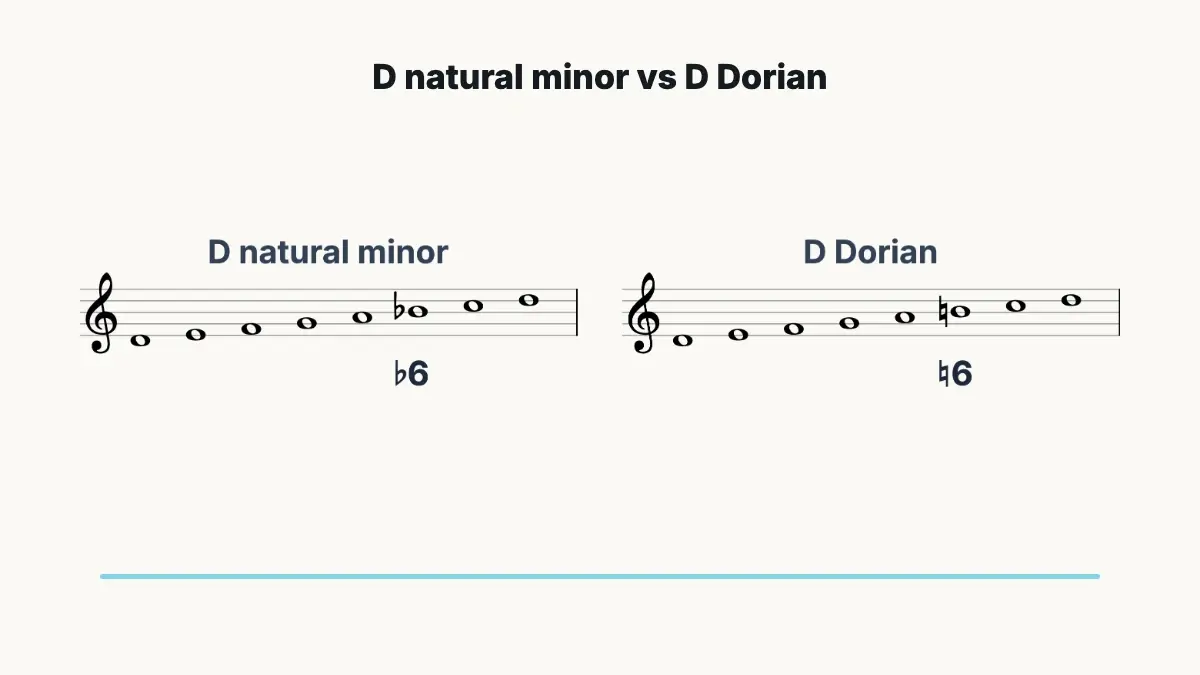
Students remember the modes more easily when each is described as a small change to a scale they already know. Lydian is major with a raised 4th. Mixolydian is major with a lowered 7th. Dorian is natural minor with a raised 6th. Phrygian is natural minor with a lowered 2nd. Locrian is natural minor with a lowered 2nd and a lowered 5th.
This gives three groups: major-sounding modes (Ionian, Lydian, Mixolydian), minor-sounding modes (Dorian, Phrygian, Aeolian), and Locrian, whose diminished 5th above the tonic makes it unstable. Play each mode over the same drone and have students name the one note that differs from major or minor.
Identify the mode of a melody
To name the mode of a melody, students read the key signature to find the parent major scale, then listen for the tonic: the note the melody keeps returning to and usually ends on. The tonic’s degree in the parent scale gives the mode.
Start with short four-bar melodies that clearly end on their tonic. Folk songs, film music, and pop songs in Dorian and Mixolydian make good listening examples, because students hear the modes used in music they recognize.
Church modes and modes of the major scale
Students may meet the term church modes. The names come from medieval and Renaissance church music, which used modes long before major and minor keys became standard. In a modern classroom, “modes of the major scale” is the clearest description, because it connects each mode to a scale students already know.
Common mistakes with modes
The most common mistake is treating a mode as the parent scale with a different starting note, without a new home note. D Dorian is only D Dorian when D sounds like home. Use a drone or a bass note until students hear the difference.
Students also confuse the parent key with the mode tonic, and forget that the key signature comes from the parent scale. Have them write the parent scale above every mode they build, and circle the tonic.
A one-week practice plan
Monday: listen to Dorian and natural minor over a drone, then learn the seven names in order. Wednesday: build modes with the parent-scale method, with a written check. Friday: compare each mode with major or minor and identify the mode of short melodies.
The Modes chapter of the Music Theory Teacher’s Book follows the same order and ends with mode melodies to identify, with answer keys.