

Teaching guideChords & harmony
How to teach modal mixture and borrowed chords
Modal mixture, also called borrowed chords, is the moment a major-key song suddenly darkens for a chord or two without changing key. Students hear it constantly in film scores, rock, and pop, but the theory behind it rests on one idea they already know: the parallel minor. This guide teaches mixture by ear first, then shows how to find the borrowed notes, spell the most common borrowed chords, and tell mixture apart from a real change of key.
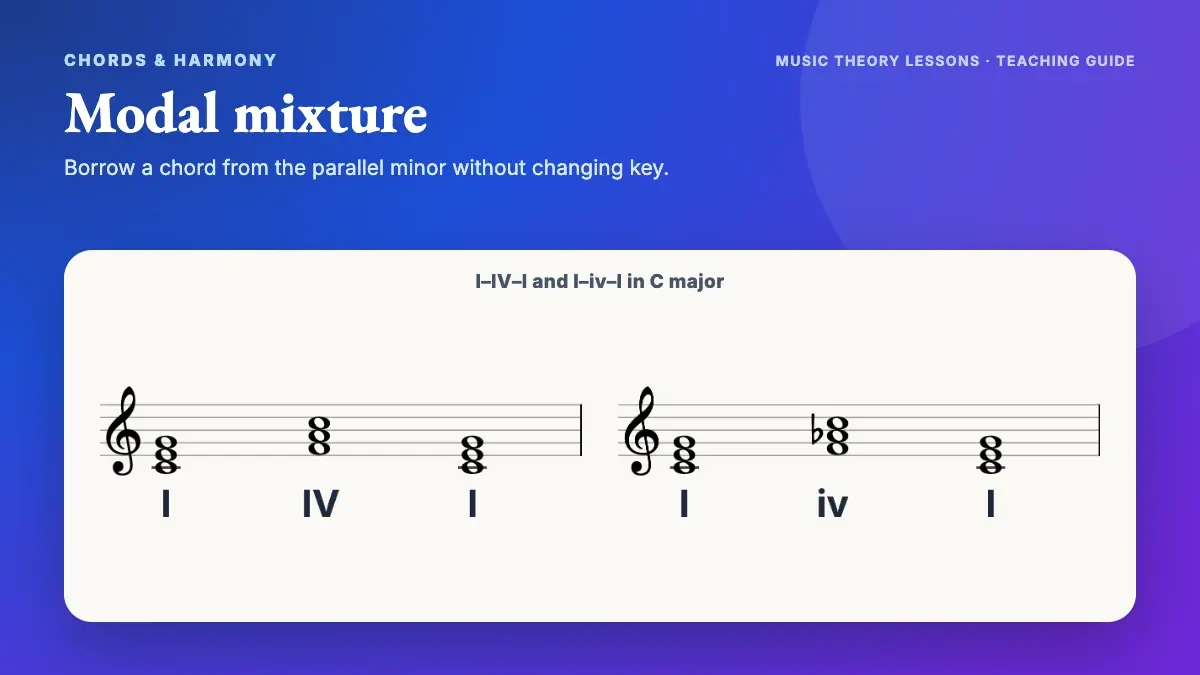
Let students hear a borrowed chord first
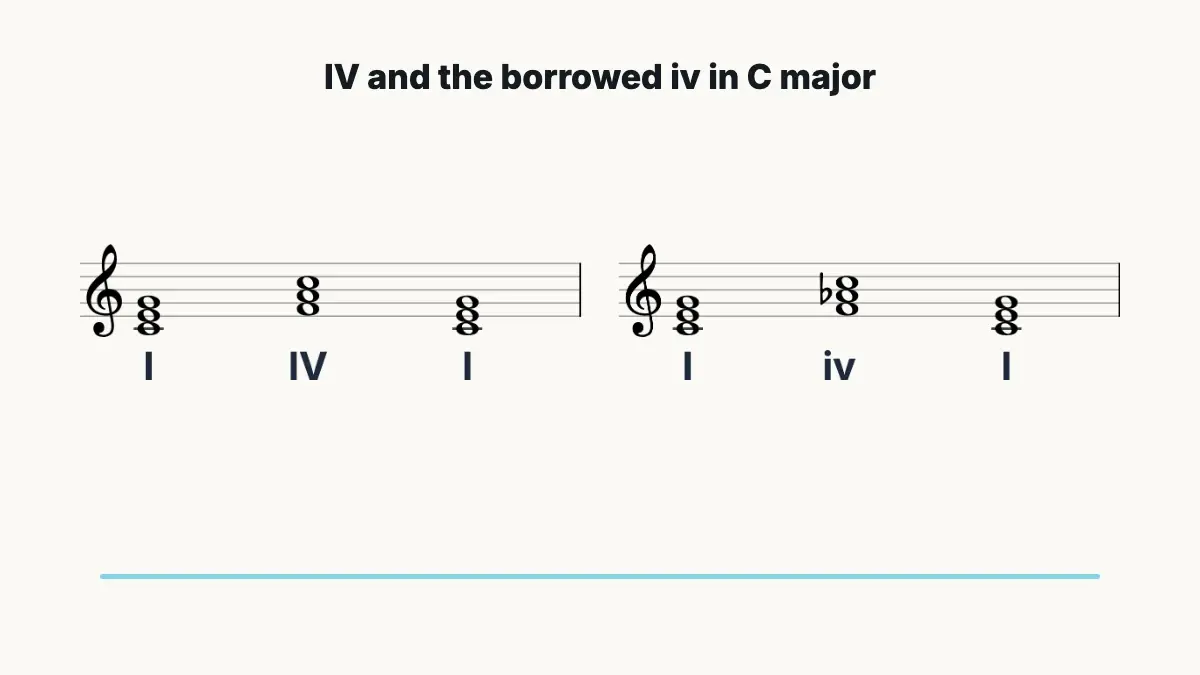
Play I–IV–I in C major, then play I–iv–I, changing only the A in the F chord to A♭. Ask students what changed. They will hear the second version darken for a moment and then return home, still clearly in C major.
That is modal mixture: a chord borrowed from another mode adds color, but the key stays the same. Students who have heard it are ready to explain where the borrowed note comes from.
Start from the parallel minor
Most borrowed chords come from the parallel minor, the minor key with the same tonic. C major and C minor are parallel keys. Contrast this with relative keys, which share a key signature: C major and A minor are relative, not parallel.
The Music Theory Teacher’s Book adds one detail worth making explicit: parallel keys share the same tonic spelling. C major and C♯ minor are not parallel, because C and C♯ are different tonics.
Lower degrees 3, 6, and 7
To turn a major scale into its parallel natural minor, lower degrees 3, 6, and 7 by a semitone and keep the other degrees the same. In C major, E becomes E♭, A becomes A♭, and B becomes B♭. These three lowered notes are the source of every common borrowed chord.
Keep the letter names when you lower a note. In D major, the 3rd degree F♯ is lowered to F♮, not to some other letter. A lowered degree does not always carry a flat sign; it is simply one semitone below the major-key version.
The most common borrowed chords
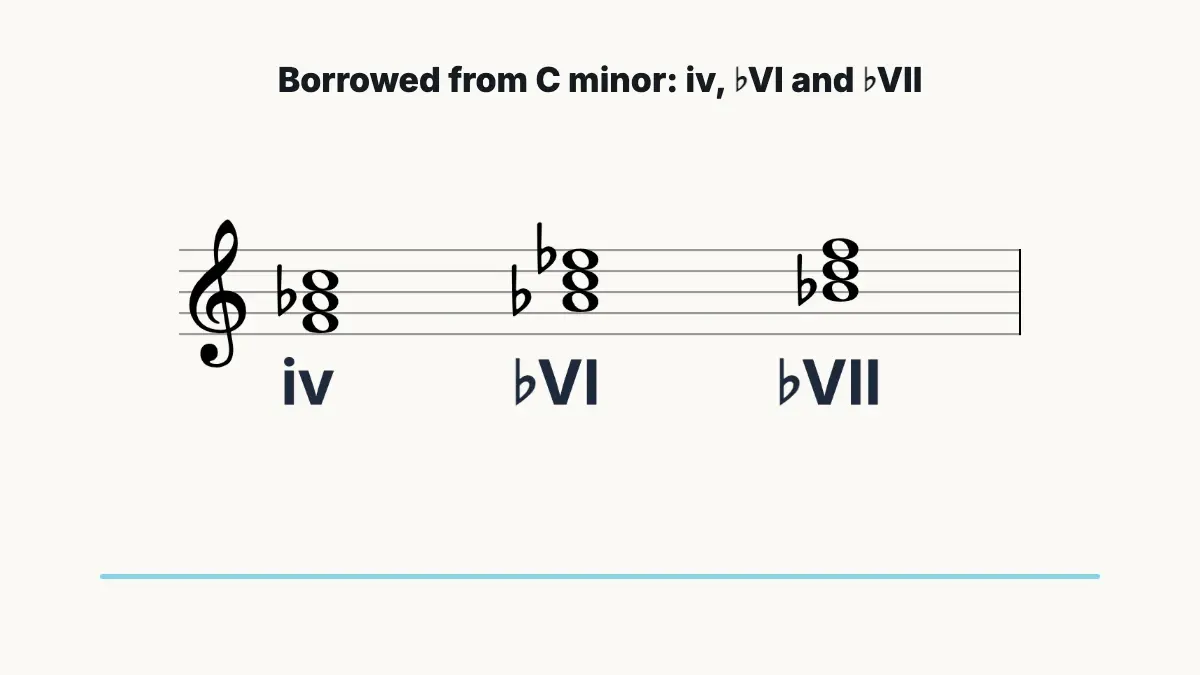
Start with iv, the minor subdominant: F–A♭–C in C major. Then add ♭VI, A♭–C–E♭, and ♭VII, B♭–D–F. These three cover most of the borrowed chords students will hear in popular and film music.
For older students, add ♭III (E♭–G–B♭), the diminished ii° (D–F–A♭), and the half-diminished iiø7 (D–F–A♭–C), which often appear as predominant chords before V in classical music.
Have students write each borrowed chord under the major key signature, using accidentals. Keeping the major signature reinforces that the key has not changed.
Label borrowed chords with Roman numerals
The case of the numeral shows the chord’s quality, as usual, and a flat before the numeral shows that the root is a semitone lower than the major-key degree. In G major, ♭VI is E♭–G–B♭: its root, E♭, is a semitone below E, the 6th degree of G major.
The flat in the label describes the root’s scale degree, not the note in the bass. A ♭VI chord in first inversion still uses the label ♭VI6.
Mixture or a change of key?
A single chromatic chord does not prove a change of key. If the music borrows iv or ♭VI and then returns through V to the major tonic, it is still in the major key. A modulation sets up a new tonic and stays there, usually confirmed by a cadence in the new key.
Show students both in short examples. A progression such as I–♭VI–V–I in C major ends firmly in C, while a passage that cadences repeatedly in G has moved to a new key.
Modal mixture, borrowed chords, and modal interchange
Students will meet several names for the same idea. Modal mixture and mode mixture are common in classical theory books, borrowed chords is the plain-language term, and modal interchange is often used in jazz and popular music. All describe chords taken from a parallel mode while keeping the same tonic.
The idea also works in reverse. Ending a minor-key piece on a major tonic chord, called a Picardy third, borrows that chord from the parallel major.
Common mistakes
Students often borrow from the relative minor instead of the parallel minor, respell lowered notes with a different letter, such as G♯ for A♭, or write a new key signature for one borrowed chord. Have them name the parallel minor key and its three lowered degrees before they write anything.
Another frequent error is calling every chromatic chord a borrowed chord. Secondary dominants, such as V/V, also add accidentals, but they do not come from the parallel minor.
A one-week practice plan
Monday: hear I–IV–I and I–iv–I, then parallel and relative keys. Wednesday: lower degrees 3, 6, and 7 and build iv, ♭VI, and ♭VII in several keys, with a written check. Friday: label borrowed chords in short progressions and decide whether each passage stays in its key.
The Modal Mixture chapter of the Music Theory Teacher’s Book follows the same order, from parallel keys to iv and ♭VI in context, with answer keys.