

Teaching guideChords & harmony
How to teach Roman numeral analysis
Roman numeral analysis is where the separate skills of a theory course come together: keys, triads, seventh chords, inversions, and cadences all appear in one passage of real music. Students find it overwhelming when they are handed a full score and asked to label everything. This guide gives them a four-step routine, shows how to label quality and inversion, explains chord function, and works through the opening of Bach’s Prelude in C major as an example you can use in class.
What Roman numerals show
A Roman numeral names the scale degree a chord is built on. The case shows the quality: uppercase for major, lowercase for minor, lowercase with a small circle for diminished, and uppercase with a plus sign for augmented.
In a major key the triads are I, ii, iii, IV, V, vi, and vii°. In a minor key, using the raised leading tone for the dominant and leading-tone chords, they are i, ii°, III, iv, V, VI, and vii°. Have students build these chords in one major and one minor key before they analyze any music.
Give students a four-step routine
The Music Theory Teacher’s Book uses the same order every time. First, find the key. Second, set the harmonic rhythm: mark where the harmony changes. Third, label each chord with a Roman numeral and figure. Fourth, assign each chord its function.
To find the key, students look at the key signature, the last chord, and any accidentals. A key signature with no sharps or flats could be C major or A minor; frequent G♯s and a final A minor chord point to A minor.
Setting the harmonic rhythm before labeling prevents the most common beginner mistake: writing a new Roman numeral under every note. Many passages keep one harmony for a whole beat or measure.
Label inversions with figures
The figure after a Roman numeral shows which chord tone is in the bass. A root-position triad needs no figure, a first-inversion triad is labeled 6, and a second-inversion triad is labeled 6/4. Seventh chords use 7 in root position, 6/5 in first inversion, 4/3 in second inversion, and 4/2 in third inversion.
Teach students to find the bass note first and the chord second. The case of the numeral shows the quality and the figure shows the inversion, so V6 and V6/5 are both dominant chords, one a triad and one a seventh chord.
Group chords by function
Once chords are labeled, ask what job each one does. Tonic chords, such as I and often vi, feel at rest. Predominant chords, such as IV and ii, lead toward the dominant. Dominant chords, such as V, V7, and vii°, pull strongly back to the tonic.
Most phrases follow the same path: tonic, predominant, dominant, tonic. Showing students that path turns a string of numerals into a story with a beginning, a middle, and an ending. A harmony can also last across more than one chord: I and I6 are both tonic, so the tonic area continues.
Worked example: Bach’s Prelude in C major
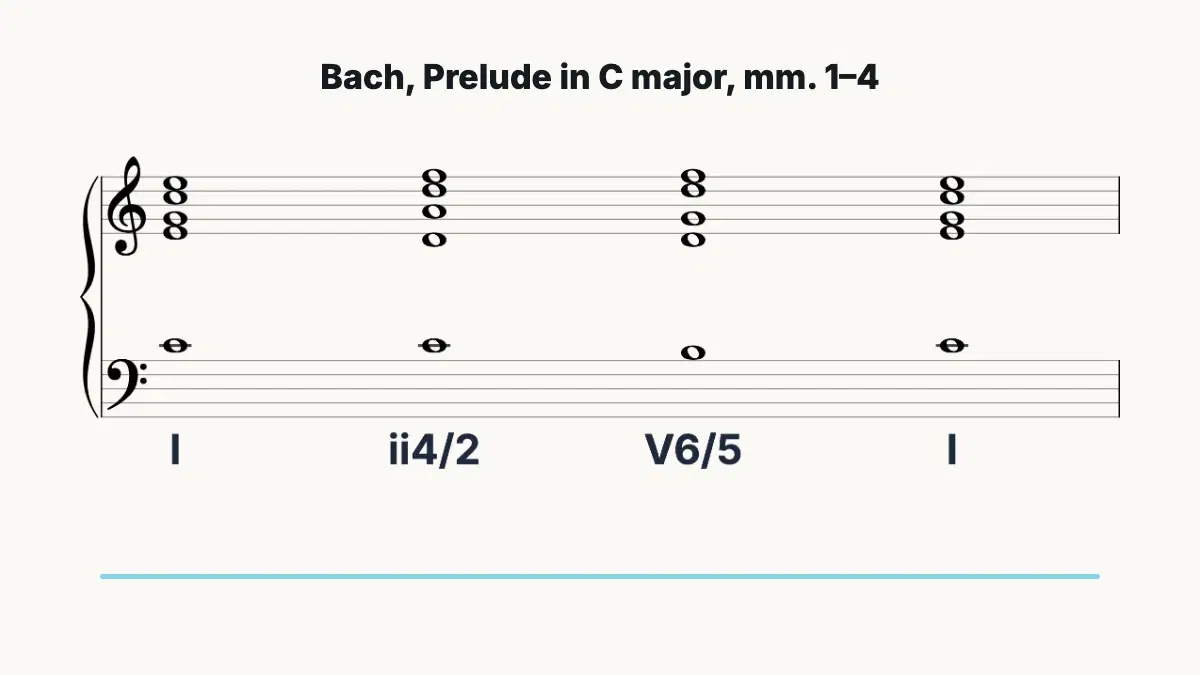
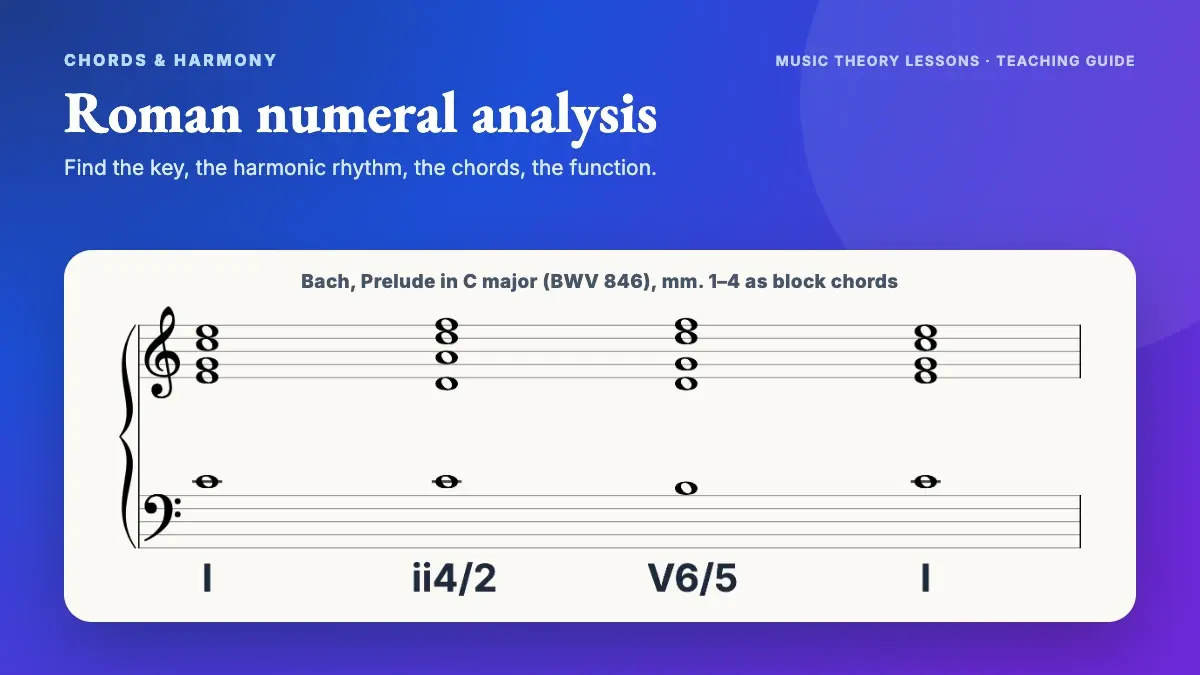
The Prelude in C major from Book 1 of Bach’s Well-Tempered Clavier is ideal for a first analysis, because each measure holds one harmony spelled out as a broken chord. Have students stack the notes of each measure into a block chord before they label it.
In the first four measures, measure 1 is a C major chord, I. Measure 2 is D, F, A, C over a C in the bass, a supertonic seventh chord in third inversion, ii4/2. Measure 3 is G, B, D, F over a B in the bass, a dominant seventh chord in first inversion, V6/5. Measure 4 returns to I.
Then add the functions: tonic, predominant, dominant, tonic. In four measures students see the whole path of a phrase, and they see why the inversions keep the bass line moving by step: C, C, B, C.
Separate chord tones from non-chord tones
Not every note in a passage belongs to the chord. Passing tones move by step between two chord tones, and neighbor tones step away from a chord tone and return to it. If students try to include them in the chord, they end up with chords that do not exist.
Have students choose the chord from the bass and the notes on strong beats, then circle any remaining notes and name them as passing or neighbor tones.
Common analysis mistakes
Students often analyze before finding the key, label a new chord under every note, read the inversion from the top note instead of the bass, or use the wrong case for the quality. The four-step routine prevents most of these.
In minor keys, the most common error is writing v instead of V. Because the leading tone is usually raised, the dominant chord is normally major, so remind students to look for the accidental on the 7th degree.
A one-week practice plan
Monday: Roman numerals for every triad in one major and one minor key, with a quick labeling check. Wednesday: inversion figures and functions, using short chord progressions. Friday: the four-step routine on a real passage, ending by naming the cadence.
The Harmonic Analysis chapter of the Music Theory Teacher’s Book takes students from chord function through inversions and non-chord tones to real repertoire, including Bach, with answer keys.