

Teaching guideChords & harmony
How to teach chord spelling
Chord spelling builds on interval fluency. Start with root-position triads on the staff, connect to chord symbols when quality is reliable, and add sevenths when diatonic triads in a key make sense. Generate fresh chord worksheets each class so students practice spelling, not one fixed answer sheet. Piano, choir, and theory-class students share the same spelling foundation even when their repertoire differs.

What students need before chords
Secure interval number and quality — especially major and minor thirds — before a chord unit. Triads are stacks of thirds; if students cannot find a third on the staff, spelling C-E-G will feel arbitrary.
Key signatures and scale spelling should be familiar so diatonic triads in a key are the next logical step.
If students struggle, return to interval worksheets for one week before continuing — chord frustration is often interval gap, not chord difficulty.
Choir students who read vocal lines fluently may still need harmonic spelling practice — do not assume melodic reading equals triad fluency.
Triad quality before symbols
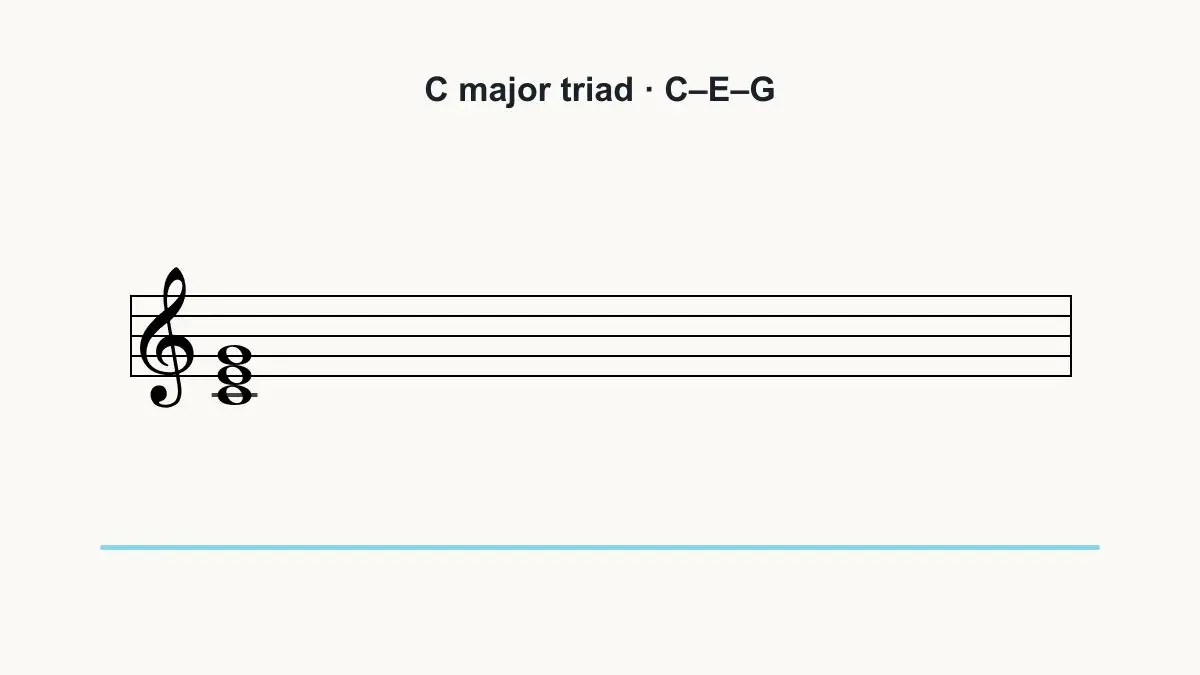
Use root-position triads on the staff first: major, minor, diminished, augmented. Students spell from a given root, then identify quality from written notes.
Connect to chord symbols and Roman numerals only when spelling is steady — symbols are shorthand for what students can already hear and write.
Use a consistent voicing (root position only) for the first month so quality is the focus, not bass-line movement.
Have students hum each pitch of the triad after spelling — ear connection prevents quality labels from becoming arbitrary letters.
Spell triads in a key
Build I, ii, iii, IV, V, vi (and vii° if required) from the major scale students already know. One key per week keeps cognitive load manageable.
Generate chord spelling worksheets in the same key as the piece students are rehearsing so theory class matches ensemble music.
Have students play or sing arpeggiated triads after spelling — connecting ear, hand, and notation.
Label each diatonic triad with Roman numerals only after students can spell the triad without the numeral — the numeral is a name for a sound they already own.
Add inversions after root position
Teach figured bass or inversion symbols after root-position spelling is fluent. Students should recognize bass-note changes by ear and on the staff before memorizing figured-bass shorthand.
Separate worksheets for root-position triads and inversions when students confuse the two.
Label inversion practice with the same Roman numerals students see in analysis — I6 and V6 are vocabulary, not separate topics.
Add sevenths when triads are steady
Introduce dominant and major sevenths after diatonic triads in a key make sense. Seventh chords add a fourth pitch — wait until triad quality is automatic.
Use choir, jazz, or piano contexts to justify why sevenths matter in the music students actually play.
Split dominant seventh spelling from major seventh until students stop confusing the two qualities on assessments.
When sevenths appear in repertoire before your theory unit, preview the dominant seventh as “the chord that wants to go home” — motivation before full spelling rules.
Spell chords from the score students already have
Circle tonic, subdominant, and dominant harmonies in a simplified score excerpt — students spell only the chords they will hear in concert.
Piano and guitar classes can analyze lead-sheet symbols for the same progression they are performing; band and choir can stay with concert-pitch spelling in one key.
Regenerate chord worksheets when the concert key changes so homework always matches the folder on the stand.
Common chord spelling mistakes
Starting with lead-sheet symbols before staff spelling skips the skill you are trying to build. Mixing Roman numerals from different keys on one worksheet too early creates avoidable errors.
Skipping ear training and reusing one chord worksheet all term are equally common — sing triads, regenerate sheets, and match the key of current repertoire.
Put it into practice this week
Spell root-position triads in one key daily (I, IV, V minimum). Add a chord identification worksheet mid-week and a short dictation of a familiar progression by ear on Friday.
Use the same key as the ensemble piece when possible — theory homework should feel like rehearsal support.
When students miss quality, return to interval thirds for two days before adding more chord symbols.