

Teaching guideChords & harmony
How to teach cadences in music theory
A cadence is the punctuation at the end of a musical phrase: some endings sound like a full stop, others like a comma or a surprise. Students learn cadences best when they hear those endings before they label them. This lesson sequence starts with listening, then teaches students to find the last two chords of a phrase and sort them into authentic, half, deceptive, and plagal cadences, with real music and printable practice for each step.
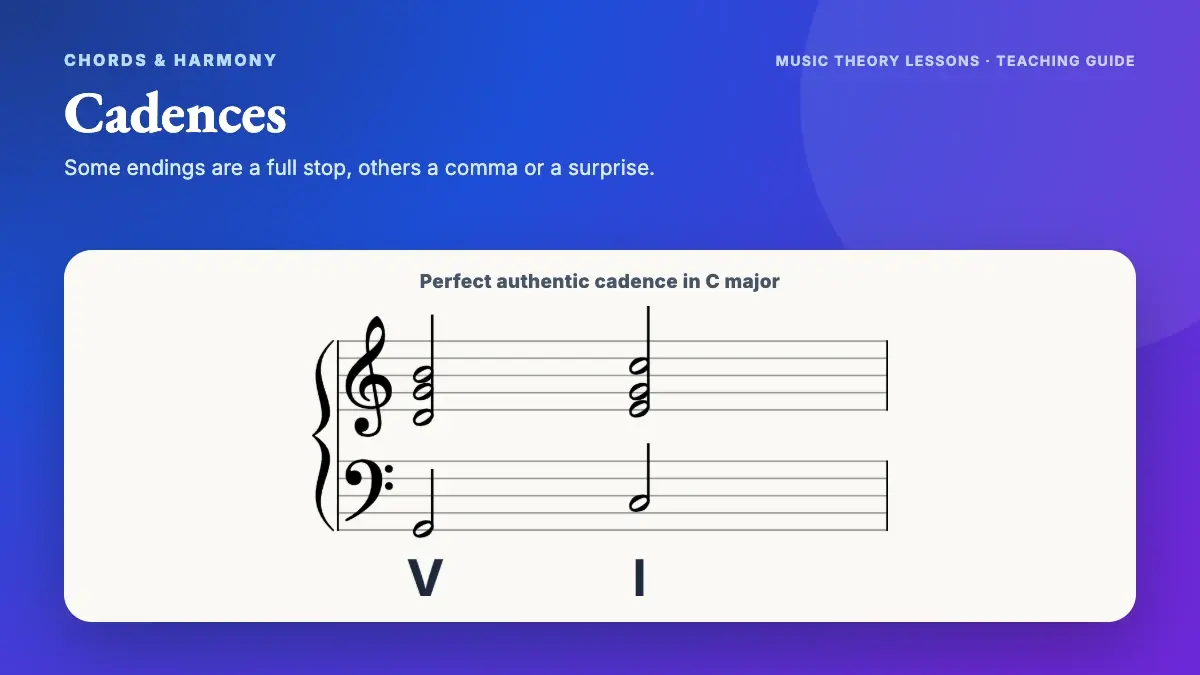
Start by hearing where phrases end
Play or sing a short folk song or hymn and stop just before the final note. Students will groan, because the music feels unfinished. Then play it again to the end. That feeling of arrival is what a cadence creates, and it is the best introduction to the topic.
Next, play two phrases from the same piece, one that ends at the halfway point and one that ends at the very end. Ask which one sounds like a comma and which sounds like a full stop. Students who can hear the difference are ready to learn the names.
Teach students to look at the last two chords
Every cadence is named by the last two chords of a phrase. Students need to find the end of the phrase, name the key, and label those two chords with Roman numerals: I for the tonic, IV for the subdominant, V for the dominant, and vi for the submediant.
If Roman numerals are new, spend a lesson building triads on each degree of the scale first. Cadence work goes much faster when students can label I, IV, V, and vi at a glance.
Authentic cadences: V to I
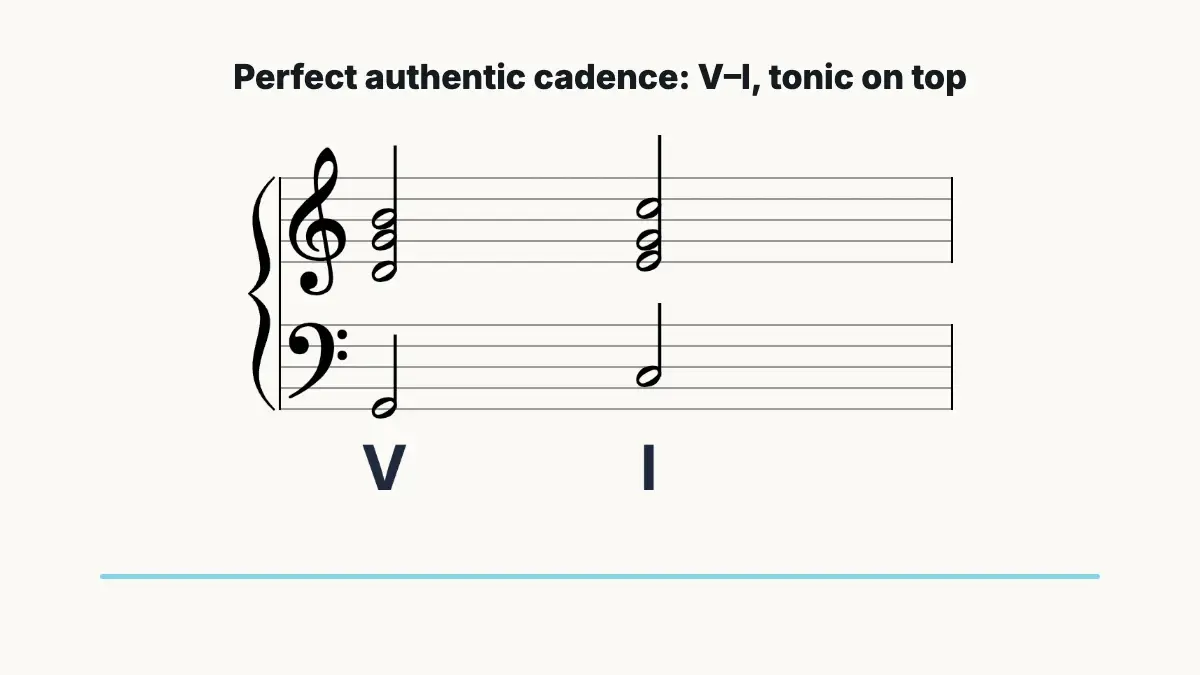
An authentic cadence moves from V to I, or to i in a minor key. It is the strongest ending in tonal music, because the leading tone, a semitone below the tonic, rises to the tonic.
Teach two strengths. A perfect authentic cadence has both chords in root position, with the root in the bass, and the tonic as the top note of the final chord. It sounds completely finished. An imperfect authentic cadence still moves V to I, but either the top note of the last chord is not the tonic or one of the chords is inverted, so it sounds slightly less final.
For advanced students, show how a cadential 6/4, I6/4 to V to I, often prepares a strong authentic cadence. The 6/4 chord sits over the dominant note in the bass, so it belongs to the dominant and delays it.
Half cadences: ending on V
A half cadence ends on V. Like a comma, it sounds open and unfinished, which is why it often closes the first phrase of a pair. The chord before V is often I, IV, or ii.
In minor keys, introduce the Phrygian half cadence once the basic types are secure: iv6 to V, where the bass falls by a semitone, F to E in A minor.
Deceptive cadences: a surprise ending
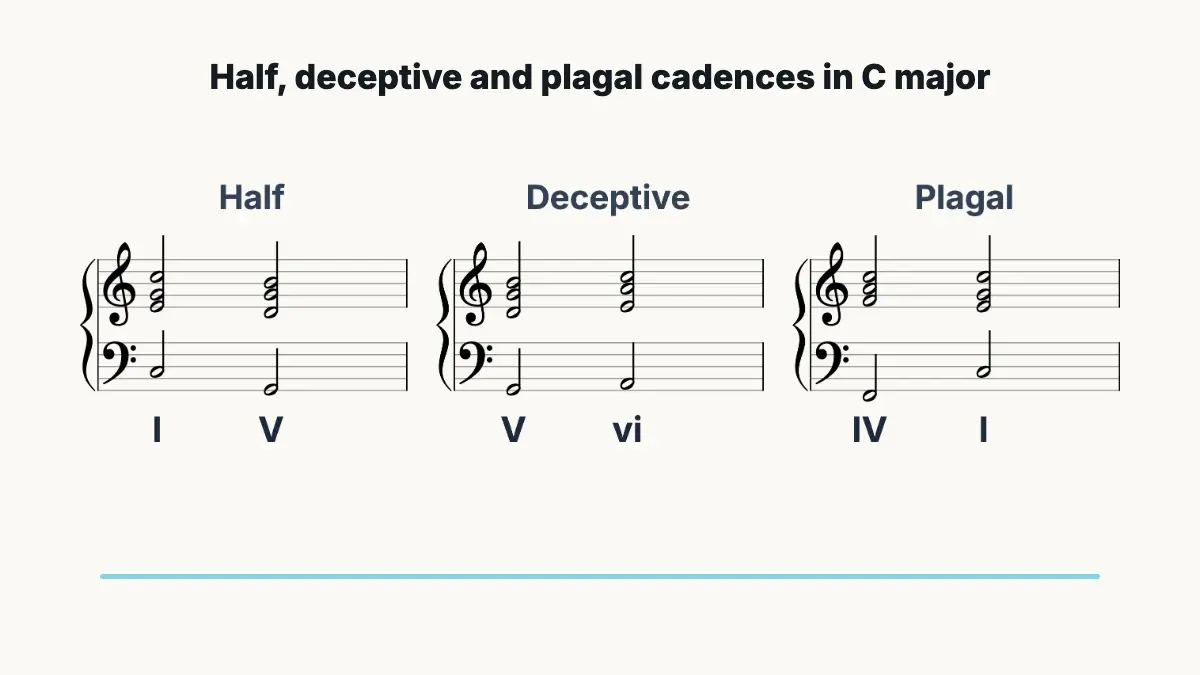
A deceptive cadence starts with V, so the listener expects I, but it moves to vi instead, or VI in a minor key. The music sounds as though it was about to end and then changed its mind.
Play an authentic cadence and a deceptive cadence back to back. Students usually laugh at the deceptive one, which makes it the easiest cadence to remember.
Plagal cadences: the “Amen” ending
A plagal cadence moves from IV to I, or iv to i in a minor key. It reaches the tonic without using V, so it sounds gentler than an authentic cadence. Many students know it as the “Amen” sung at the end of hymns.
North American and UK cadence names
Students who use British books or exam boards will meet different names. A UK perfect cadence is V to I, which North American books call an authentic cadence. A UK imperfect cadence ends on V, which North American books call a half cadence. An interrupted cadence is the same as a deceptive cadence, and plagal is the same everywhere.
Watch for one trap: a North American imperfect authentic cadence still ends on I, while a UK imperfect cadence ends on V. Choose one set of terms for your class and give the other set once as a translation.
Find cadences in real music
Bach chorales are ideal for cadence practice. Each phrase ends with a fermata, so students can find the phrase endings at a glance, and the four-part texture makes the chords easy to read. Have students follow each phrase to its fermata, label the last two chords, and name the cadence.
Then ask students to find a cadence in a piece they are performing. Connecting the label to music on their own stand shows that cadences are how composers shape phrases, not just a theory exercise.
Common cadence mistakes
Students often name a cadence from one chord instead of two, call every V to I perfect, or forget that V is major in a minor key because the leading tone is raised. Have them write the leading tone into every V chord in minor and check the bass and top notes before choosing perfect or imperfect.
Half and deceptive cadences are also easy to mix up because both sound unfinished. Point students back to the last chord: a half cadence ends on V, and a deceptive cadence ends on vi after V.
A one-week practice plan
Monday: listen for phrase endings, then authentic and half cadences. Wednesday: deceptive and plagal cadences, with a short identification worksheet. Friday: find and name the cadences in a chorale or a piece from your current repertoire.
The Cadences chapter of the Music Theory Teacher’s Book follows the same order and ends with real Bach chorale phrases to analyze, with answer keys.