

Teaching guideChords & harmony
How to teach seventh chords
A seventh chord is a triad with one more third stacked on top. That single extra note opens up the sound of jazz, pop, and classical harmony, and it gives students the dominant seventh, the chord that pulls most strongly toward home. This guide teaches seventh chords as four recipes, shows a shortcut for spelling each one, and then finds the seventh chords that belong to major and minor keys, with printable seventh-chord practice.
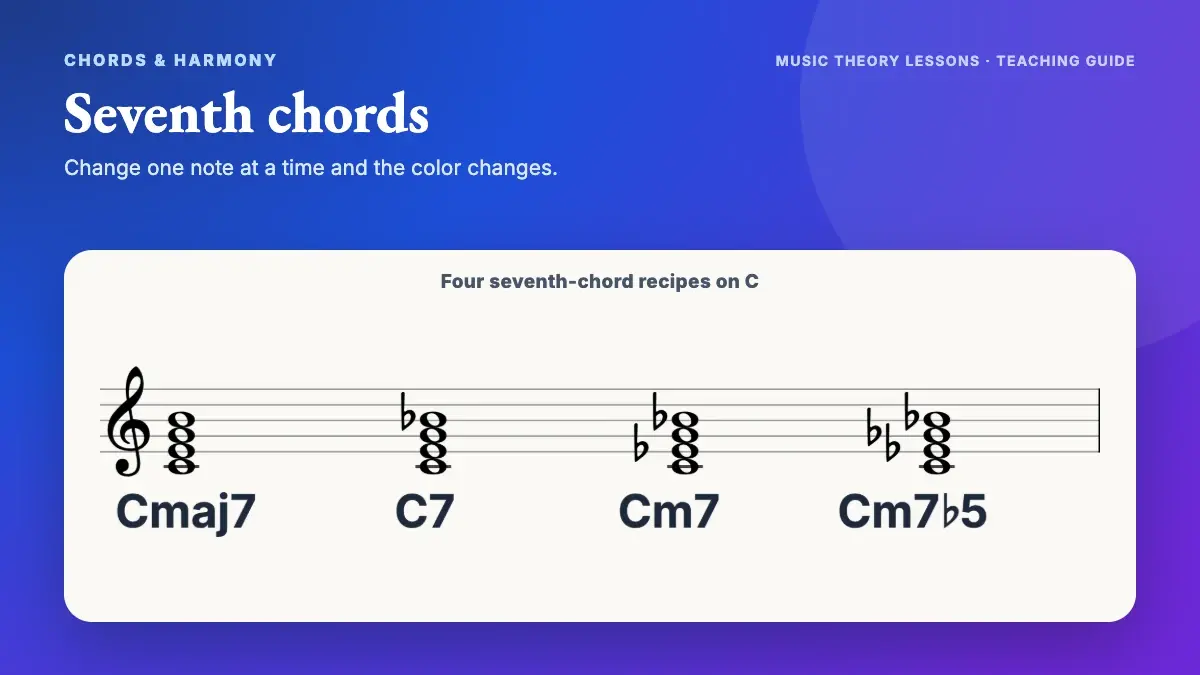
Add one more third to a triad
Have students build a triad, then stack one more third on top. The new note is a 7th above the root, which gives the chord its name. On the staff a root-position seventh chord is four lines or four spaces in a row.
Play a triad and the matching seventh chord back to back. Students hear immediately that the extra note adds color and, in some chords, tension.
Start with the dominant seventh
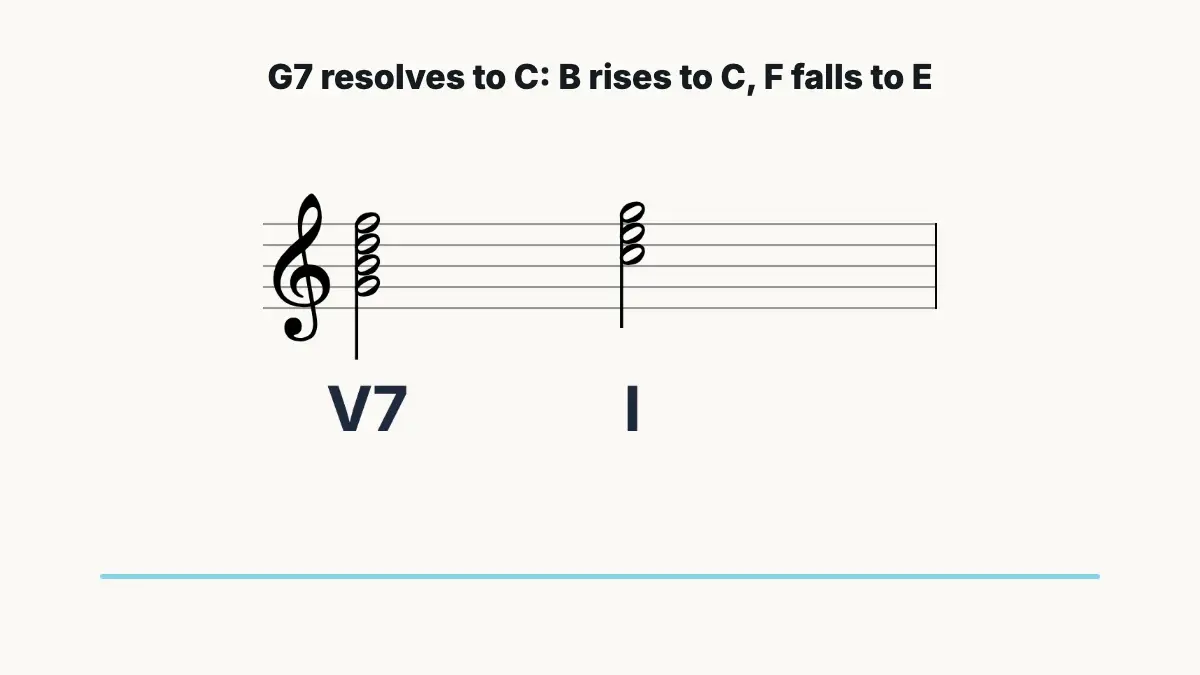
Begin with the chord students will meet most: the dominant seventh, built on degree 5. In C major the dominant is G, so V7 is G–B–D–F.
Show the tritone inside it. The third and the seventh of G7, B and F, are an augmented 4th or diminished 5th apart, and both resolve by step: B rises to C and F falls to E. That resolution into C–E–G is why V7 pulls so strongly to the tonic. In C minor the chord is the same, but the B♮ needs an accidental because it is not in the key signature.
Teach the four seventh-chord recipes
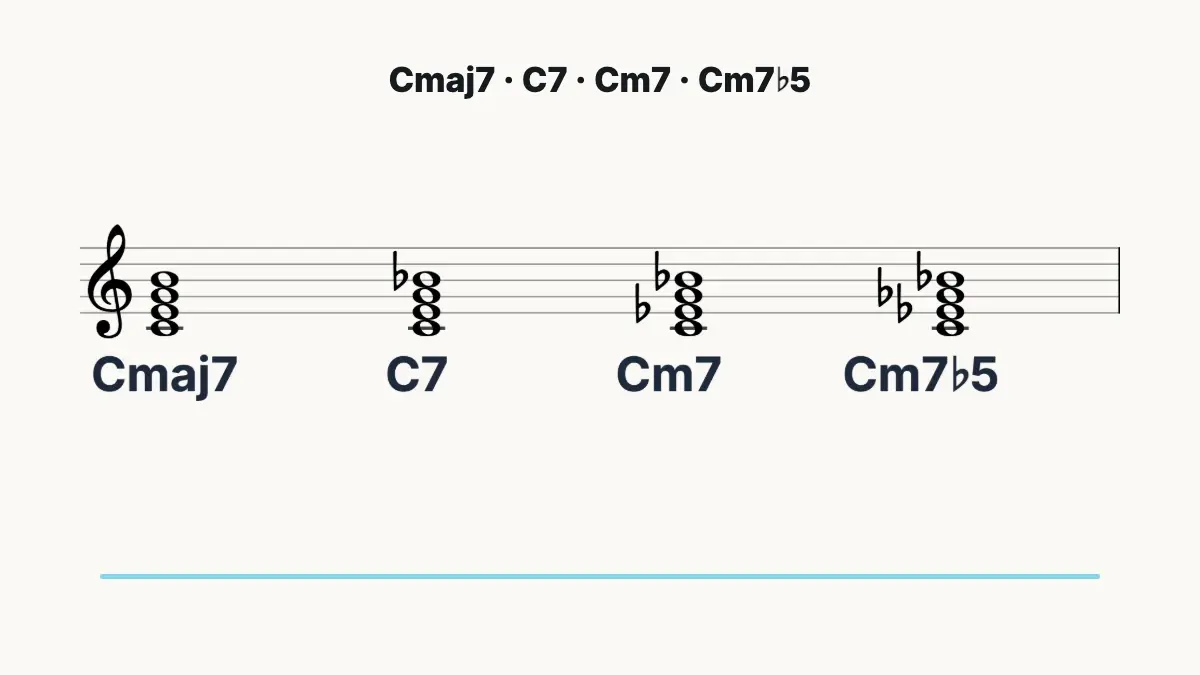
Describe each quality as a recipe of intervals above the root. A major seventh chord is a major 3rd, perfect 5th, and major 7th: Cmaj7 is C–E–G–B. A dominant seventh chord is a major 3rd, perfect 5th, and minor 7th: C7 is C–E–G–B♭. A minor seventh chord is a minor 3rd, perfect 5th, and minor 7th: Cm7 is C–E♭–G–B♭. A half-diminished seventh chord is a minor 3rd, diminished 5th, and minor 7th: Cm7♭5, also written Cø7, is C–E♭–G♭–B♭.
The Music Theory Teacher’s Book walks through these by changing one note at a time: from Cmaj7, lower B to B♭ for C7, then E to E♭ for Cm7, then G to G♭ for Cm7♭5. Students see that the root stays the same and only one chord member changes each time.
For older students, add the fully diminished seventh, a minor 3rd, diminished 5th, and diminished 7th, such as B–D–F–A♭. Keep it separate from half-diminished, which has a minor 7th.
A spelling shortcut: the triad above the root
Each recipe has a triad hidden above its root. Cmaj7 is an E minor triad above C. C7 is an E diminished triad above C. Cm7 is an E♭ major triad above C. Cm7♭5 is an E♭ minor triad above C.
Students who know their triads can spell any seventh chord quickly this way, then check it against the interval recipe.
Read chord symbols correctly
Chord symbols cause many mix-ups. A plain 7, as in D7, always means a dominant seventh chord: D–F♯–A–C. Dm7 has a minor third instead: D–F–A–C. Dmaj7 has a major seventh: D–F♯–A–C♯.
Have students say the full name aloud for every symbol, such as “D dominant seventh,” before they spell it. Most errors come from reading maj7 and 7 as the same thing.
Find the diatonic seventh chords of a key
Stack a seventh chord on every degree of C major using only notes of the scale. I and IV are major sevenths, ii, iii, and vi are minor sevenths, V is the only dominant seventh, and vii is half-diminished, viiø7. The pattern is the same in every major key.
In A minor, the scale supplies most of the chords, but the leading tone is usually raised for a stronger pull to the tonic. The chord on degree 5 becomes the dominant seventh E7, V7, and the chord on degree 7 becomes the fully diminished G♯°7, vii°7.
Separate quality from function
A chord’s quality is its recipe; its function is the job it does in a passage. Cmaj7 is the tonic in C major, but Fmaj7 has the same quality and is not the tonic. C7 leads to F as V7 in F major, yet in a blues in C it can be the home chord.
Keeping quality and function separate prevents a common misunderstanding: that a dominant seventh chord must always be V7.
Common seventh chord mistakes
Students often confuse major seventh and dominant seventh chords, call a half-diminished chord diminished, forget the raised leading tone in V7 in a minor key, or spell the seventh with the wrong letter name. Ask them to check the interval from the root to the seventh, major or minor, on every chord.
A one-week practice plan
Monday: build seventh chords from triads and hear the dominant seventh resolve. Wednesday: the four recipes, the triad shortcut, and chord symbols, with a short spelling check. Friday: the diatonic seventh chords of a major key and a minor key.
The 7th Chords chapter of the Music Theory Teacher’s Book covers each recipe with listening and real progressions, then the diatonic sevenths of major and minor keys, with answer keys.