

Teaching guideChords & harmony
How to teach diatonic triads
Once students can spell a single triad, the next question is which chords belong to a key. Diatonic triads answer it: build a triad on every degree of the scale using only the notes of the key, and the same pattern of major, minor, and diminished chords appears in every major key. This guide shows how to teach that pattern, label it with Roman numerals, and carry it into minor keys, with printable chord practice for each step.
Check that students can spell a triad
Diatonic triads build on two skills: stacking a root, third, and fifth, and recognizing major, minor, augmented, and diminished quality. If students still hesitate over whether C–E♭–G is major or minor, spend another lesson on chord spelling first.
Build a triad on every degree of C major
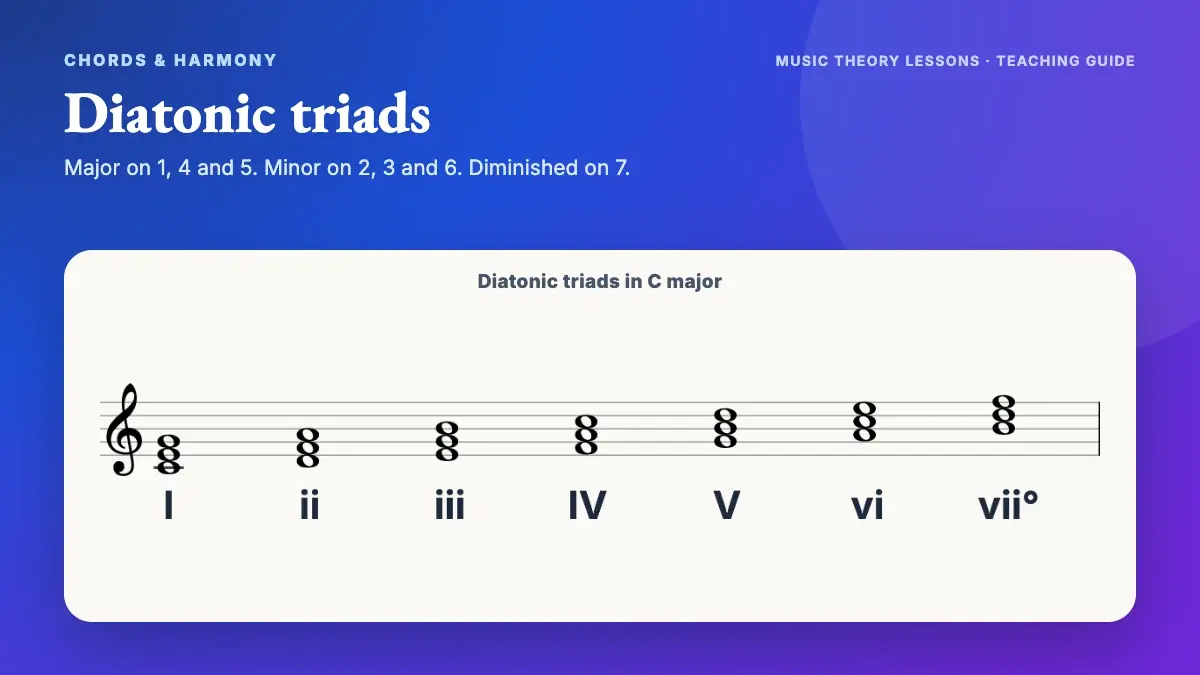
Write the C major scale, then stack two thirds above each note using only notes from the scale. On the staff, a triad is three lines in a row or three spaces in a row, which makes the stacks quick to draw. The result is C–E–G, D–F–A, E–G–B, F–A–C, G–B–D, A–C–E, and B–D–F.
Have students play each chord on a keyboard or hear it played. They will notice that some chords sound bright, some darker, and one sounds tense. That listening sets up the labels that follow.
Label the qualities with Roman numerals
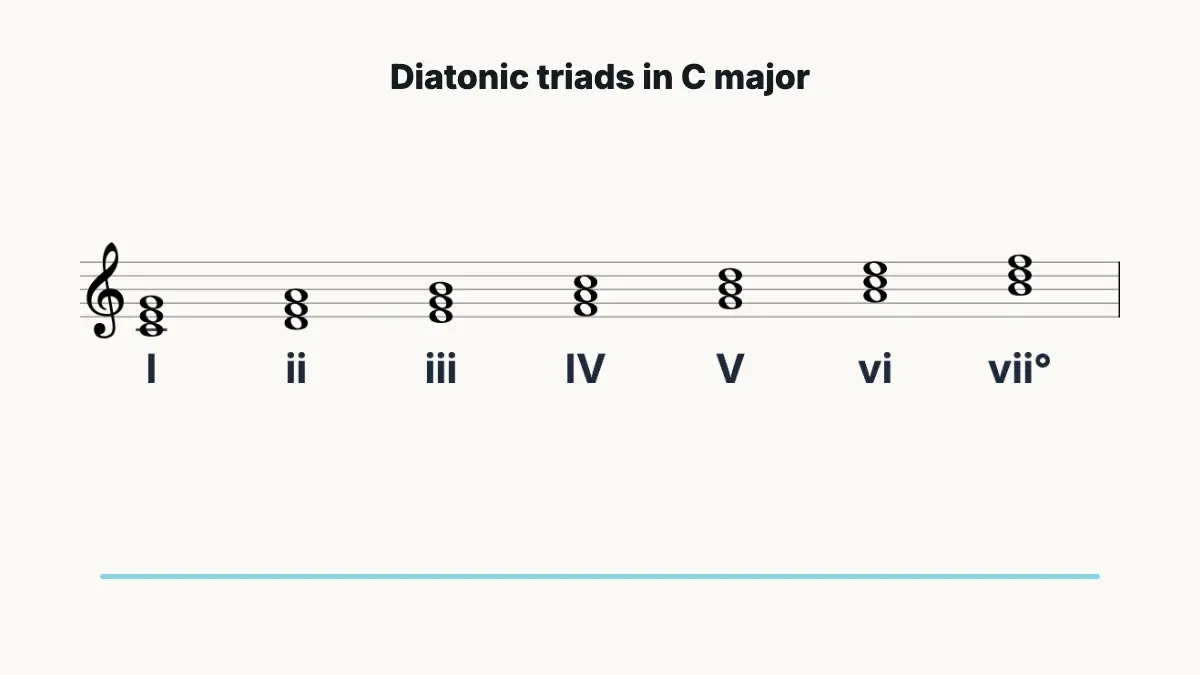
Name the quality of each chord, then write a Roman numeral for its scale degree. Uppercase means major, lowercase means minor, and a small circle means diminished. In every major key the pattern is the same: I, ii, iii, IV, V, vi, vii°.
Students only need to remember one fact to rebuild the pattern: the triads on degrees 1, 4, and 5 are major, the triads on 2, 3, and 6 are minor, and the triad on 7 is diminished. The vii° chord is diminished because the interval from B up to F is a diminished 5th.
Move the pattern to another key
Have students build the same seven chords in G major, using the key signature: G–B–D (I), A–C–E (ii), B–D–F♯ (iii), C–E–G (IV), D–F♯–A (V), E–G–B (vi), and F♯–A–C (vii°). The qualities come out exactly the same as in C major.
This is the moment the pattern clicks. Students see that “the V chord is major” is true in every major key, so they can name the chords of a new key without building every one from scratch.
Diatonic triads in minor keys
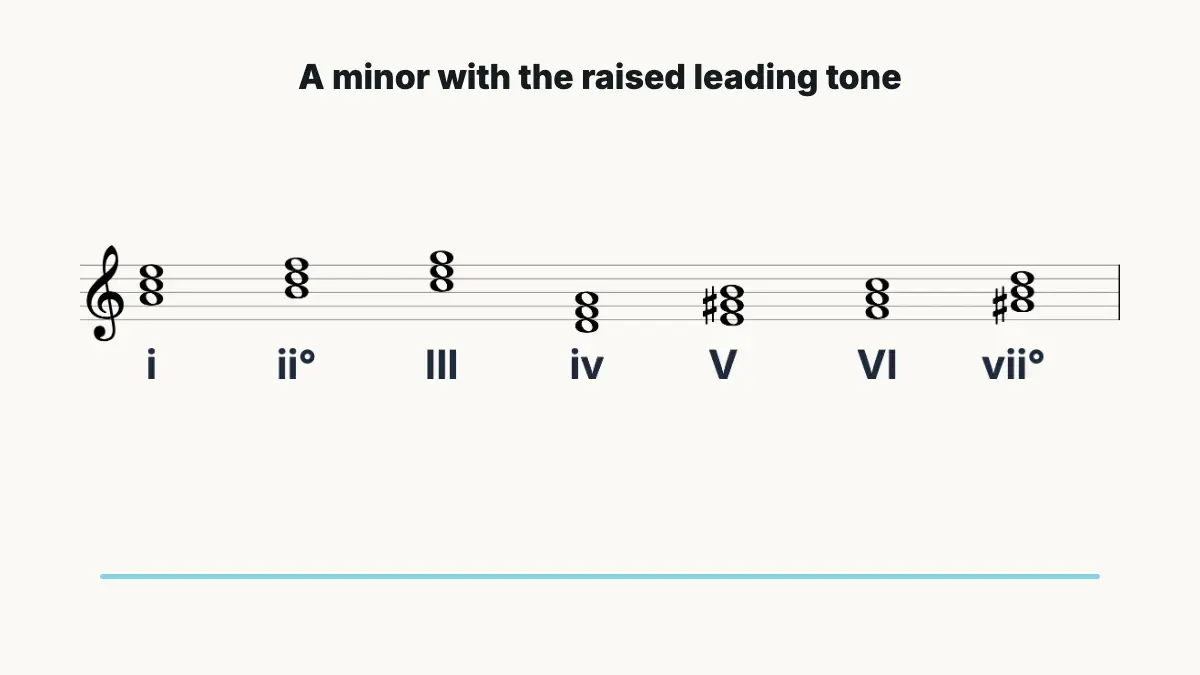
Built on the natural minor scale, the triads are i, ii°, III, iv, v, VI, and VII. In A minor that gives A–C–E, B–D–F, C–E–G, D–F–A, E–G–B, F–A–C, and G–B–D.
In practice, music in minor keys usually raises the 7th degree to create a leading tone, so the dominant becomes major, V (E–G♯–B in A minor), and the chord on the 7th degree becomes diminished, vii° (G♯–B–D). Built strictly on harmonic minor, the mediant becomes augmented, III+ (C–E–G♯), which is how the Music Theory Teacher’s Book shows the full harmonic-minor set. Point out that most music uses the major III with the natural 7th.
Connect diatonic triads to real music
Show students that I, IV, and V, the primary triads, can harmonize a huge number of simple songs. Have them accompany a familiar melody using only those three chords, then add vi or ii for color.
This prepares students for cadences and harmonic analysis, where they will meet the same Roman numerals in real music. Students who can label every chord in a key already know most of what they need.
Common mistakes
Students often add accidentals that are not in the key, write the wrong case for the quality, or forget the circle on vii°. In minor keys, the most frequent mistake is writing v instead of V when the leading tone is raised.
Have students write the quality pattern for major keys at the top of every worksheet until it is automatic, and check each chord against the key signature before labeling it.
A one-week practice plan
Monday: build and hear the seven triads of C major and label them with Roman numerals. Wednesday: build the same pattern in G and F major, with a written check. Friday: diatonic triads in A minor, including the raised leading tone, and a short accompaniment using I, IV, and V.
The Triads chapter of the Music Theory Teacher’s Book covers each step, from triad anatomy to diatonic triads in major and minor keys, with answer keys.