

How to teach sixteenth notes and advanced rhythm counting
Once students count quarter and eighth notes with a steady beat, sixteenth notes are the natural next step, and they open the door to every advanced rhythm students will meet: triplets, ties across the bar line, sixteenths in compound meter, and irregular meters such as 5/8 and 7/8. This guide picks up where our general rhythm counting guide leaves off and gives you a teaching order, the counting syllables for each step, and printable practice for each one.
Check that students are ready
Sixteenth notes go smoothly when eighth notes are already secure. Before you start, check that students can count “1 + 2 +” through a measure of mixed quarter and eighth notes, keep counting through rests, and clap the rhythm at a steady tempo without speeding up.
If any of those wobble, spend another week on eighth notes. Adding sixteenth notes to an unsteady beat only makes the rushing worse.
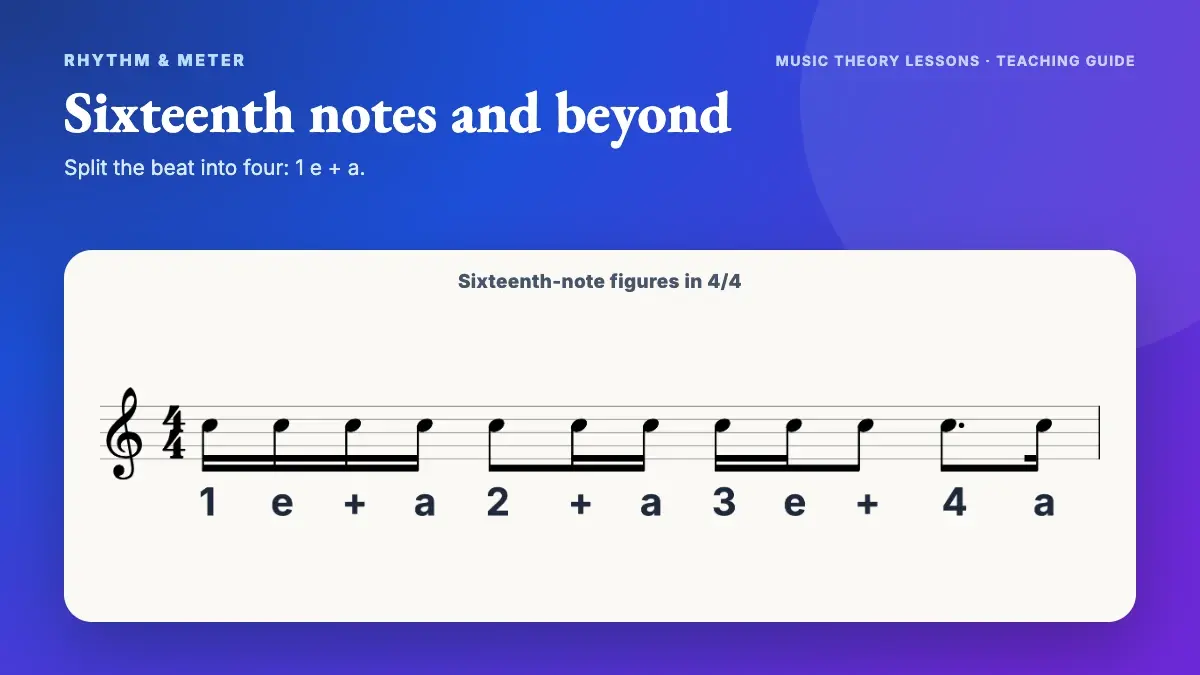
Split the beat into four: 1 e + a
A sixteenth note (semiquaver) lasts a quarter of a beat when the quarter note gets the beat, so four sixteenth notes fill one beat. Count them as the beat number, then “e,” then “+,” then “a”: 1 e + a, 2 e + a. The beat number and the “+” stay exactly where they were for eighth notes, and “e” and “a” fill the spaces between.
Have students speak the full grid slowly with a metronome before they read any notation. Then play a game from the Music Theory Teacher’s Book: keep the metronome going and clap only on one syllable, such as the “a” of beat 2. Change the target every few measures. Students who can place a single clap on any part of the beat are ready to read sixteenth-note rhythms.
Teach the beamed figures that fill one beat
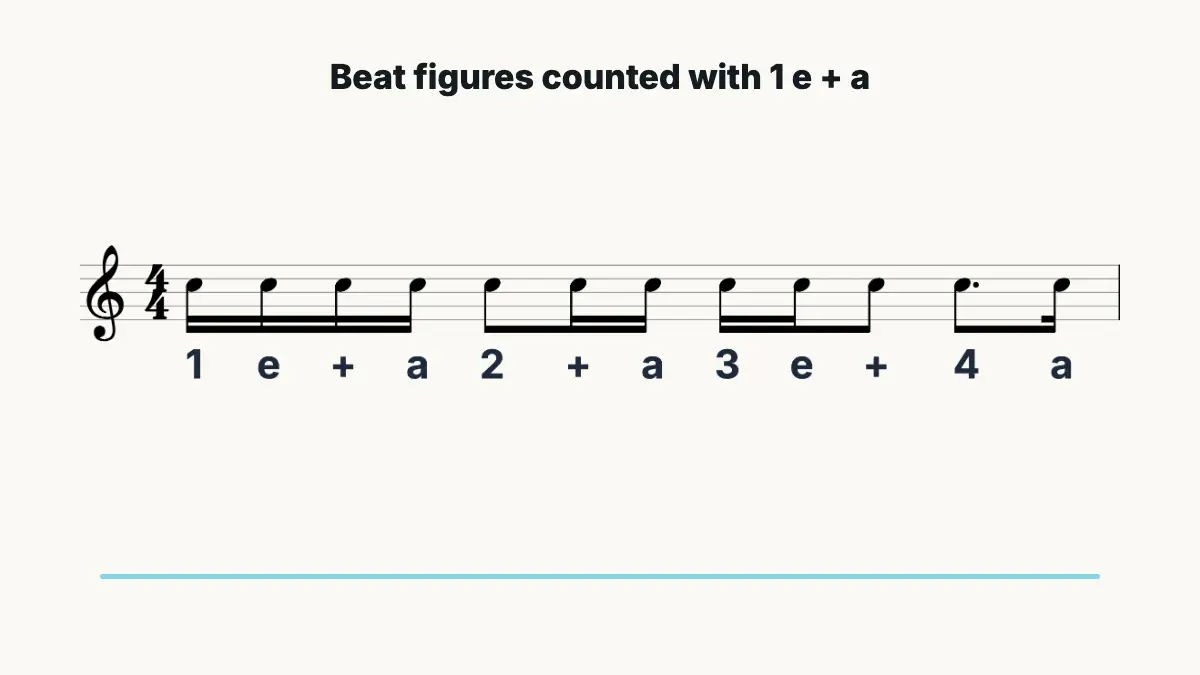
Most sixteenth-note rhythms are built from a handful of beamed figures that each fill one beat. Four sixteenth notes are counted 1 e + a. An eighth note and two sixteenth notes are counted 1 + a. Two sixteenth notes and an eighth note are counted 1 e +. A sixteenth, an eighth, and a sixteenth are counted 1 e a. A dotted eighth and a sixteenth are counted 1 a, and a sixteenth and a dotted eighth are counted 1 e.
Show each figure as four sixteenth notes with some of them tied together. An eighth note is simply two tied sixteenth notes, and a dotted eighth is three. Students who see the four-part grid underneath every figure stop memorizing shapes and start reading them.
Practice one figure at a time, then mix two figures in one measure, then all of them. Remind students that the beat number changes with the beat: the same figure is counted 3 e + on beat 3.
Add triplets: three in the space of two
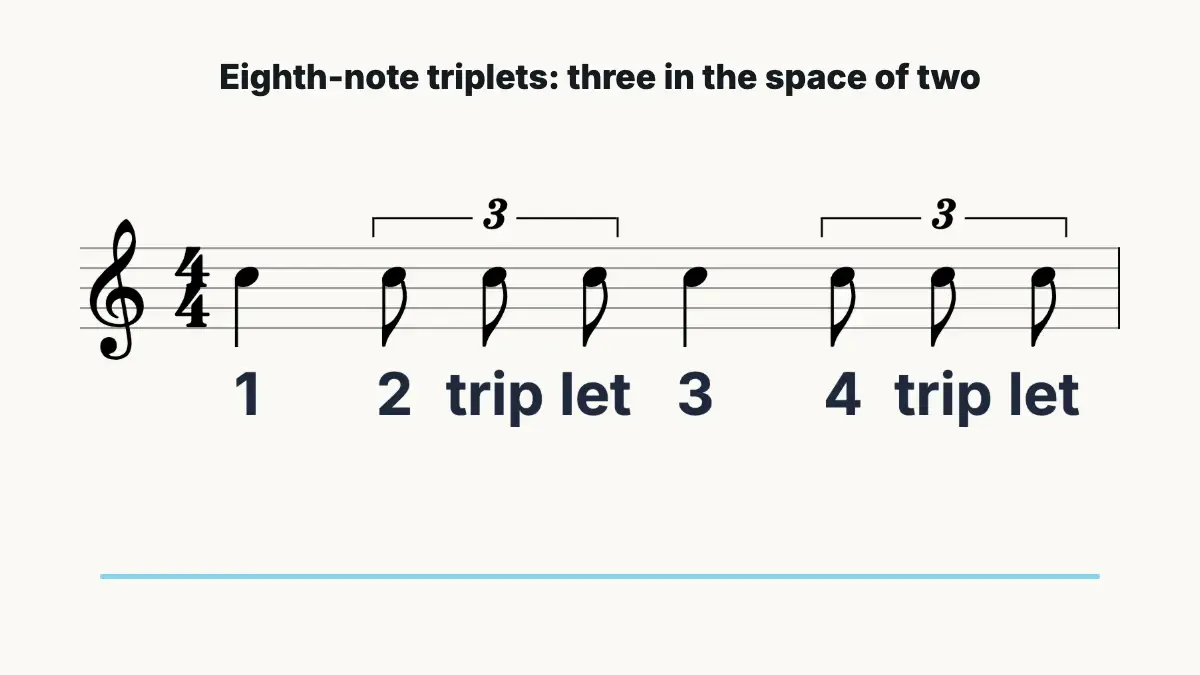
A triplet plays three equal notes in the time normally taken by two. An eighth-note triplet fits three eighth notes into one quarter-note beat, and it is marked with a bracket or beam and a 3. The Music Theory Teacher’s Book counts a triplet with the beat number followed by “trip-let”: 1 trip-let, 2 trip-let.
To teach triplets against quarter notes, split the class: one half claps steady quarter notes while the other half speaks “1 trip-let 2 trip-let.” Swap parts, then have individual students do both, tapping quarter notes with a foot and clapping the triplet. Keep the beat number lined up with the quarter-note clap so the triplet never drifts.
Contrast triplets with sixteenth notes right away. Four even sounds in a beat and three even sounds in a beat are easy to blur, and hearing them side by side keeps them separate.
Count ties and ties across the bar line
A tie joins two notes of the same pitch into one longer sound. Students count the total length of the tied notes but only say or write the syllable where the sound begins. A quarter note tied to an eighth note on beat 1 is counted 1: the sound holds through beat 2, and the next note starts on the “+” of 2.
When a tie crosses the bar line, the counting carries straight into the new measure. The held note starts in one measure and finishes in the next, and students keep counting the new beat numbers silently until the next note begins. Have students mark the beat where each tied note ends, then clap the line.
Sixteenth notes in 6/8
In compound meter the Music Theory Teacher’s Book counts each dotted-quarter beat as “1 la li,” one syllable for each eighth note. When an eighth note splits into two sixteenth notes, add “ta” between the landmarks, so one beat becomes 1 ta la ta li ta and a full measure of 6/8 is 1 ta la ta li ta 2 ta la ta li ta.
Keep 1, la, and li in their usual places and treat “ta” as the in-between syllable. Students who already count 6/8 in eighth notes only need to fill the gaps, which is the same move they made when “e” and “a” joined “1 +” in simple meter.
Count 5/8 and 7/8 with short and long beats
Irregular meters combine short beats of two eighth notes and long beats of three eighth notes. Count a short beat as the beat number and “&,” and a long beat as the beat number, “la,” and “li.” A measure of 5/8 grouped 2 + 3 is counted 1 & 2 la li; grouped 3 + 2 it is counted 1 la li 2 &.
A measure of 7/8 has three beats, and the long beat can come first, in the middle, or last. Grouped 2 + 2 + 3, it is counted 1 & 2 & 3 la li. Teach students to read the grouping from the beaming and accents before they count, because the time signature alone does not show it.
Movement helps here too. Have students step on each beat, taking a short step for a short beat and a longer step for a long one. The uneven pattern becomes physical before it becomes arithmetic.
A teaching order and practice plan
Spread the steps over several weeks: sixteenth notes and the one-beat figures first, then triplets, then ties, then sixteenths in 6/8, and finally 5/8 and 7/8. Start each lesson with a short counting warm-up from the previous step so earlier skills stay sharp.
Print a new rhythm worksheet for each step. In Worksheet Studio, the advanced rhythm level adds sixteenth notes, triplets can be switched on, and 5/8 and 7/8 are available as time signatures, so each sheet can match exactly what you taught that week.