

How to teach note and rest values
Note values make sense when students hear and feel how long a sound lasts before they memorize what the symbol looks like. This lesson sequence takes a class from clapping long and short sounds, through the full ladder of note and rest values, to dotted notes and equal-value puzzles. It works for general music, beginning band, choir, and private lessons, and it pairs with printable note and rest values worksheets that come with answer keys.
Start with sound, not symbols
Keep a steady beat on a drum or with a soft clap and have students sing or hum one pitch for one beat, two beats, then four beats. Ask them to show the length with their hands, sliding them apart while the sound lasts. Students who have felt the difference between a short and a long sound will learn the matching symbols far faster than students who start from a chart.
For this first lesson, say clearly that the quarter note gets one beat. That is true in 4/4, 3/4, and 2/4, the meters most beginners read, and it gives every other value a fixed reference. Students meet meters with a different beat note later, once the relationships between values are secure.
Finish the warm-up by holding sounds against your beat: a whole note across four beats, a half note across two, a quarter note on every beat. Students are now ready to see what those sounds look like on the page.
Build the note value ladder
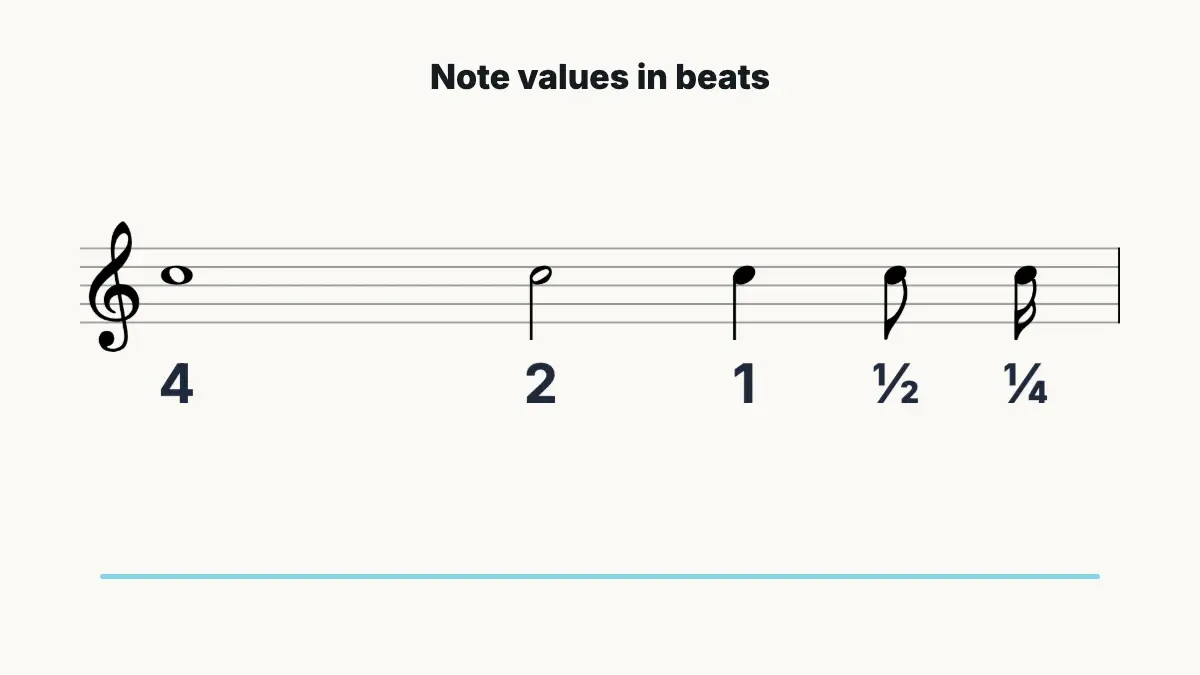
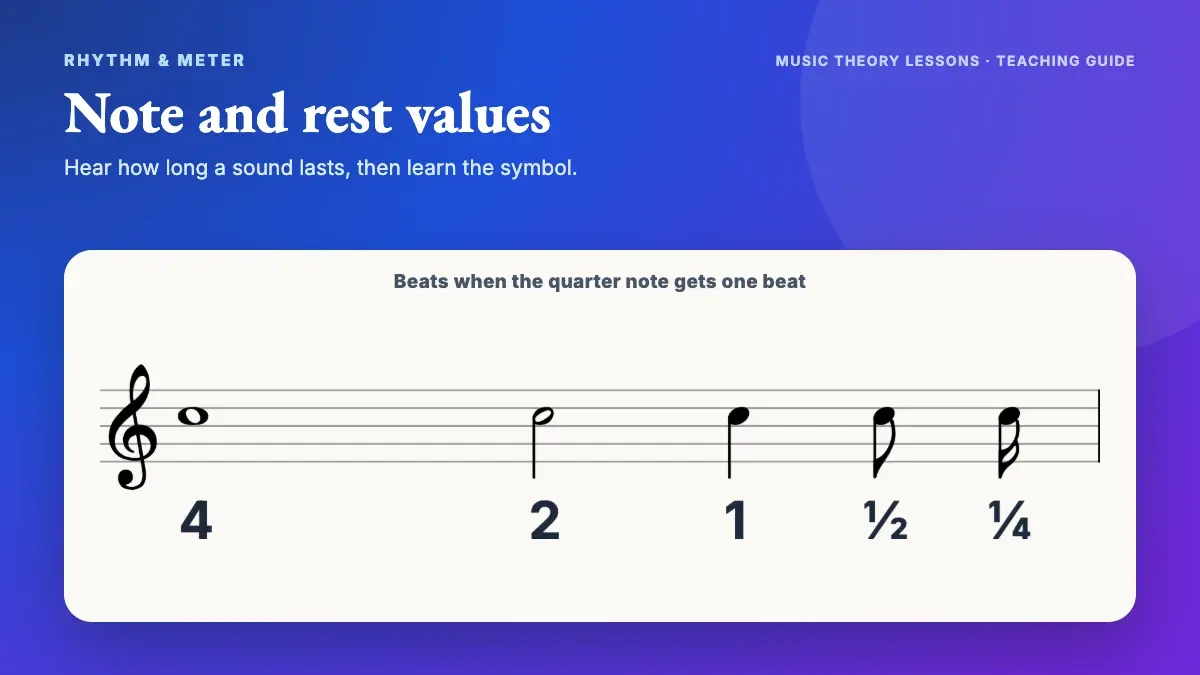
Draw the note value tree on the board: one whole note, two half notes, four quarter notes, eight eighth notes, and sixteen sixteenth notes. Each row lasts exactly as long as the row above it. When the quarter note gets one beat, the whole note lasts 4 beats, the half note 2, the quarter note 1, the eighth note half a beat, and the sixteenth note a quarter of a beat.
Point out what changes from one row to the next: the note head fills in from half note to quarter note, and every flag or beam halves the value again. Students who notice that pattern can work out a value they have forgotten instead of guessing.
If you teach students who will meet British method books or exam papers, give both names once: whole note (semibreve), half note (minim), quarter note (crotchet), eighth note (quaver), and sixteenth note (semiquaver). Then use one set of names consistently in class.
Teach rests as measured silence
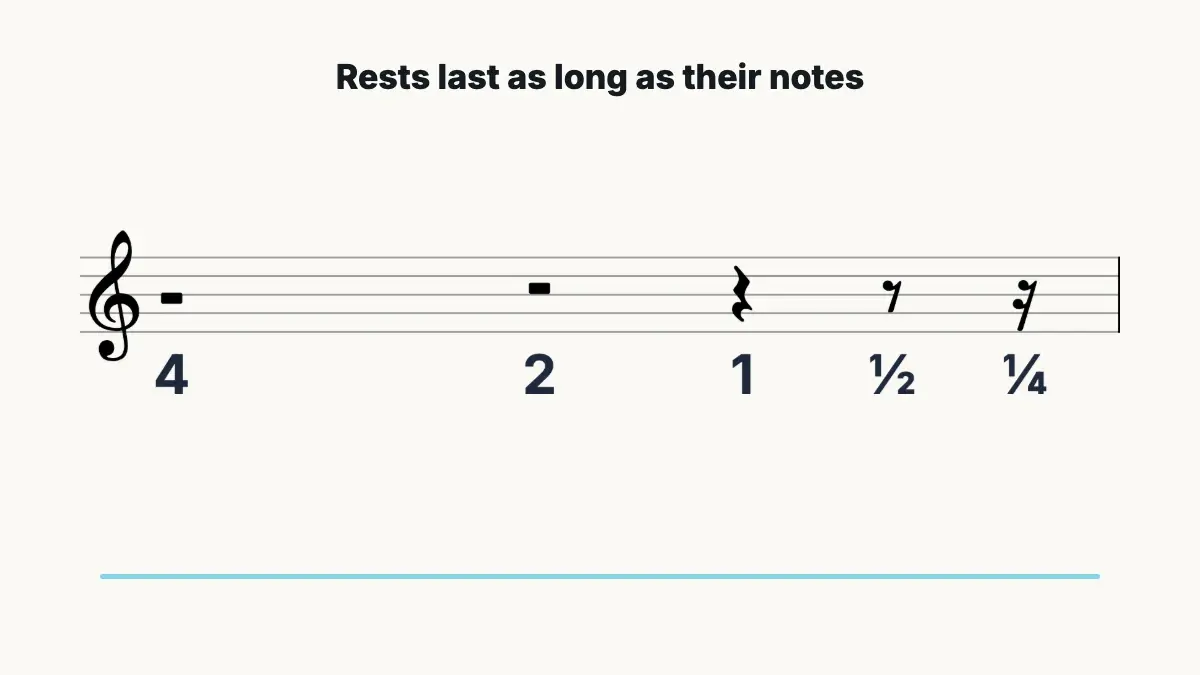
Every note value has a matching rest, and a rest lasts exactly as long as its note. Introduce rests the same way you introduced notes: keep the beat going, sing a short phrase, and replace one note with silence while everyone keeps counting on the inside. Students should feel that a rest is part of the rhythm, not a pause in it.
The whole rest and the half rest look alike, so give students a reliable way to tell them apart. The whole rest hangs down from the fourth line; the half rest sits on top of the middle line. Many teachers say the whole rest is heavy enough to hang and the half rest is light enough to sit.
Add one rule that saves confusion later: a whole rest can fill an entire measure of silence in any time signature, even 3/4 or 6/8, where a whole note would not fit.
Explain dotted notes as “add half”
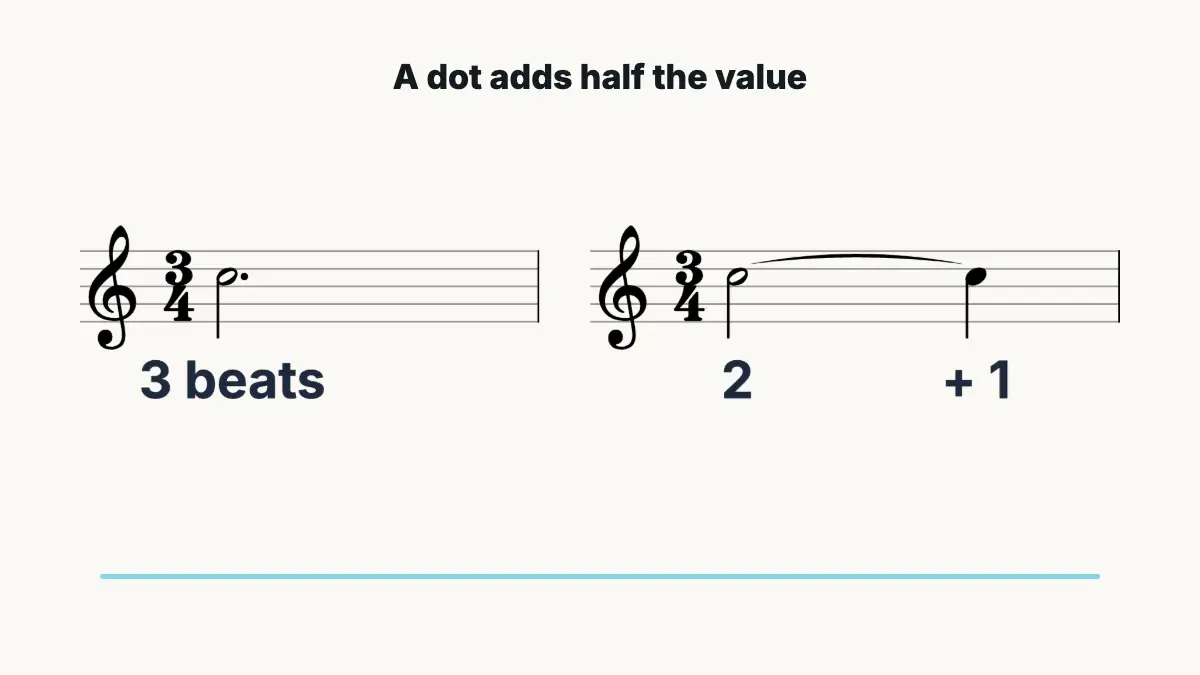
A dot after a note adds half of that note’s value. A dotted half note is 2 beats plus 1, so it lasts 3 beats. A dotted quarter note is 1 beat plus half a beat, so it lasts one and a half beats. A dotted eighth note lasts three quarters of a beat. Dotted rests follow exactly the same rule.
Show the same length two ways on the board: a half note tied to a quarter note, and a dotted half note. Students see that the dot is a shorter way to write the tie, and they can check any dotted value by rewriting it as a tie.
The most common dotted rhythm students will play is a dotted quarter note followed by an eighth note: a long sound that crosses the beat, then a short one that completes it. Clap it against a steady beat before students read it, and the long-short feel will be familiar when it appears in their music.
Use equal-value puzzles to check understanding
Once students know the values, ask them to trade a group of notes for one note of the same length: two quarter notes equal one half note, a half note and a quarter note equal one dotted half note, and four sixteenth notes equal one quarter note. Then reverse the puzzle and have them split a long value into shorter ones.
Equal-value puzzles show whether a student understands the relationships or has only memorized the beat counts. They also prepare students for ties, for combining rests, and for completing measures in a time signature.
Add beaming and stem direction
Eighth and sixteenth notes are usually beamed together in groups that show the beat, so students can see where each beat starts. Show a measure of separate flagged eighth notes next to the same rhythm beamed in pairs and ask which is easier to read.
Teach the middle-line rule for stems at the same time: notes below the middle line take stems up on the right of the note head, notes above it take stems down on the left, and notes on the middle line usually take stems down. Neat stems make students’ own rhythm writing much easier to check.
Common mistakes to catch early
Students often swap the whole rest and the half rest, count a dotted half note as two and a half beats, or stop counting during rests. Quick daily checks catch all three: hold up a symbol, have the class say its value, then clap it against your beat.
Another frequent mistake is treating beat values as permanent. In 6/8, for example, the dotted quarter note carries the beat. Tell students now that the values they are learning are relationships, and the time signature will tell them which note gets the beat.
A one-week practice plan
Monday: sound-first warm-up and the note value ladder. Wednesday: rests and a note and rest values worksheet as an exit ticket. Friday: dotted notes, equal-value puzzles, and a short rhythm students clap and then write.
Print a fresh worksheet for each check so students read the symbols instead of remembering a page. The Note Values chapter of the Music Theory Teacher’s Book covers every step in this sequence with printable exercises and answer keys if you want a ready-made unit.