

How to teach simple and compound meter
Students understand meter when they feel how the beat divides before they try to decode a time signature. This guide gives you a classroom sequence for simple and compound meter: move to the music, ask one question about each beat, read the time signature, and then compare the meters students mix up most, 3/4 and 6/8. Each step ends with practice you can print with an answer key.
Move to the meter before you name it
Play a march, a waltz, and a lively 6/8 piece, and have students move to each one: marching steps for the march, a sway with a strong first step for the waltz, and a skipping or galloping step for the 6/8. Ask them to clap only on the strongest beat of each measure (bar). Most classes find the downbeat quickly once their feet are involved.
Next, ask students to count the beats between downbeats. The march gives two or four, the waltz three, and the 6/8 piece two long beats that each feel like a skip. Students have now felt duple and triple meter, and they have felt a beat that divides into three, before anyone writes a time signature on the board.
Ask one question: how does each beat divide?
Simple and compound meter differ in one thing. In simple meter each beat divides into two equal parts. In compound meter each beat divides into three. Have students tap the beat with one hand and fill it in with the other: two even taps per beat in the march, three in the 6/8 piece.
That question also tells students which note carries the beat. In simple meter the beat is a plain note, such as a quarter note, which splits into two eighth notes. In compound meter the beat is a dotted note, such as a dotted quarter note, which splits into three eighth notes.
The number of beats in each measure then gives the full name. Two beats is duple, three is triple, and four is quadruple, so a march in 2/4 is in simple duple meter and a piece in 6/8 is in compound duple meter.
Read the time signature the right way
In simple meter the top number is the number of beats in each measure and the bottom number shows the beat note: 4 is a quarter note, 2 is a half note, and 8 is an eighth note. 2/4 is simple duple, 3/4 is simple triple, and 4/4 is simple quadruple.
In compound meter the top number counts the divisions, not the beats. Divide it by three to find the beats: 6/8 has two dotted-quarter beats, 9/8 has three, and 12/8 has four. That makes 6/8 compound duple, 9/8 compound triple, and 12/8 compound quadruple.
Treat 3/8 as simple triple, with three eighth-note beats in each measure. At a fast tempo it is often felt as one beat per measure, which makes a good discussion point once students are confident with the rule.
Compare 3/4 and 6/8 side by side
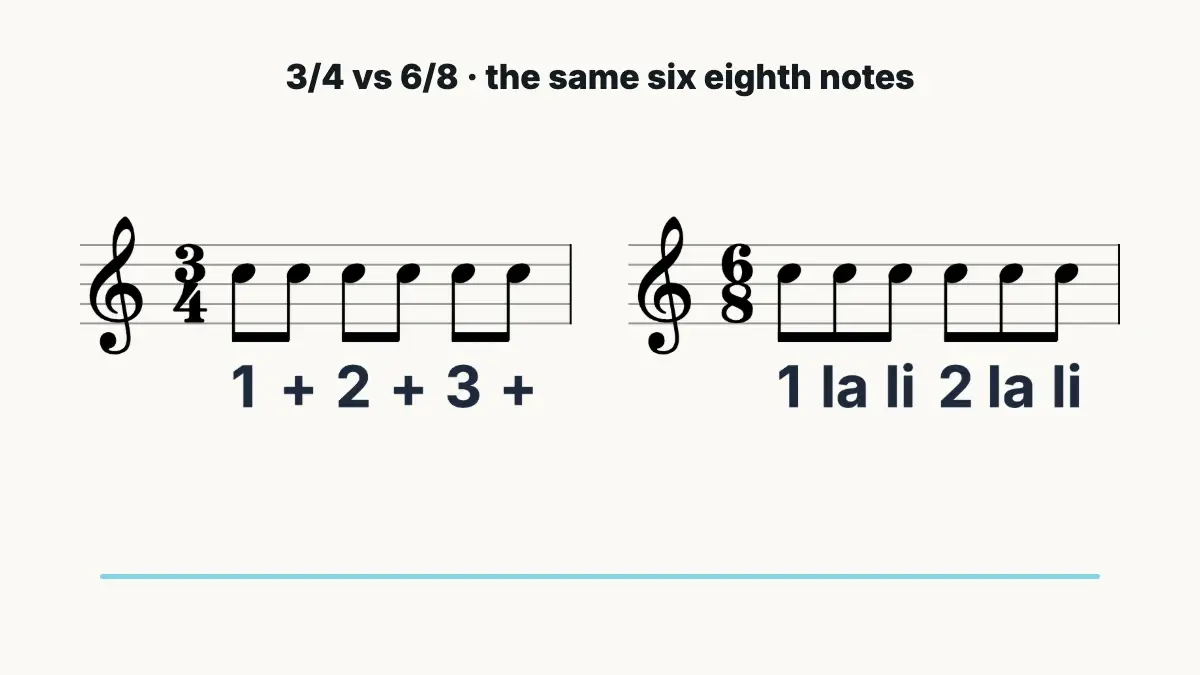
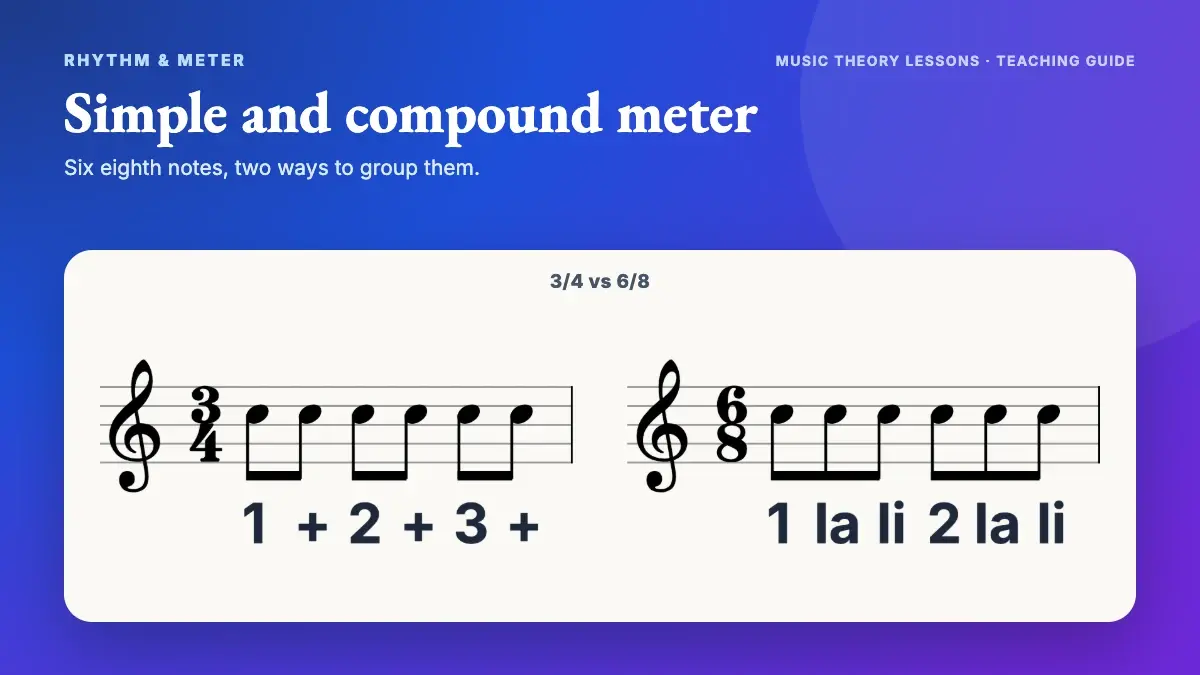
Both time signatures hold six eighth notes in a measure, which is why students confuse them. In 3/4 the six eighth notes group into three pairs, one pair for each quarter-note beat. In 6/8 they group into two sets of three, one set for each dotted-quarter beat.
Write the same six eighth notes twice on the board, beamed 2 + 2 + 2 for 3/4 and 3 + 3 for 6/8, and clap both with an accent on each beat. Students hear three strong points in one and two in the other. Then conduct them: a three-beat pattern for 3/4 and a two-beat pattern for 6/8.
Ask students to explain the difference in their own words before you move on. If they can say “3/4 has three beats that each divide into two, and 6/8 has two beats that each divide into three,” they have the concept.
Choose one way to count compound meter
Count simple meter with beat numbers and “and”: 1 + 2 + 3 +. For compound meter you have three common choices. Counting every eighth note as 1 2 3 4 5 6 is easy to start but hides the two beats. Counting 1 & a 2 & a keeps the beats clear, but students already use “&” and “a” for other parts of the beat in simple meter.
The Music Theory Teacher’s Book uses Eastman counting, 1 la li 2 la li, because its syllables never collide with simple-meter counting and the beat numbers stay obvious. Whichever system you choose, post it in the room and use it in every rehearsal so students hear the same language every time.
Let students compose in each meter
Give students one measure of 3/4 and one of 6/8 and ask them to write four measures of rhythm in each, using only values they know. Composing forces them to group notes correctly: a dotted quarter note fills a beat in 6/8, while in 3/4 it ends halfway through the second beat.
Have partners clap each other’s rhythms and decide which meter they are in without looking at the time signature. Listening for the beat division is the skill that transfers to new music.
Common meter mistakes
The most common mistake is reading the top number of a compound time signature as the number of beats, so 6/8 becomes “six beats.” At a very slow tempo a conductor may beat 6/8 in six, but students should first learn that the music is organized in two beats.
Students also beam 6/8 rhythms in pairs, as if they were in 3/4, and assume every measure counts to four. Check beaming whenever students write rhythms, and keep a few measures of 2/4 and 3/4 in every set of practice so 4/4 never becomes the default.
A one-week practice plan
Monday: movement and the one-question test. Wednesday: reading time signatures and a time signature worksheet as an exit ticket. Friday: 3/4 versus 6/8 with clapping, conducting, and a short composition.
Print a new set of measures for each lesson so students read the meter rather than recognize a page. Matching the meter of the worksheet to the music on the stand makes the practice feel useful.