

Teaching guideKeys, scales & intervals
How to teach transposition in music
Transposition moves a melody into a new key without changing its shape: every note moves by the same interval, and the rhythm stays exactly the same. Students who can transpose understand intervals and key signatures more deeply, and band students finally see why their part looks different from the flute part. This guide gives you a teaching sequence from simple melodies to written and concert pitch, with printable transposition practice for each step.
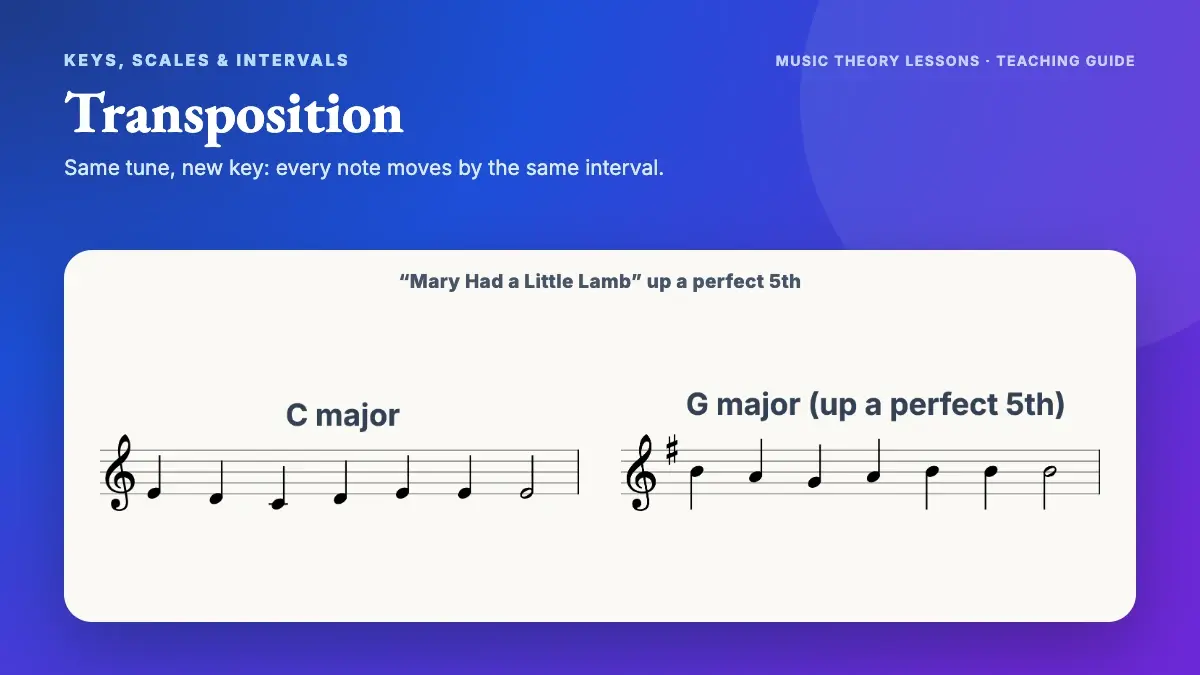
Start with the same tune in a new key
Sing or play a familiar melody, such as “Mary Had a Little Lamb,” starting on C, then sing it again starting on G. Ask students what changed and what stayed the same. They will notice that the tune is higher but every step and leap has the same shape, and that is the definition you want them to own.
Write the rule on the board: in a transposition every note moves by the same interval. If someone changes the rhythm, adds a note, or moves only some of the notes, the result is a different melody, not a transposition.
Method 1: move every note by the interval
To transpose by a named interval, count letter names from each note, remembering that the interval number includes both the starting and the ending letter. Up a 5th from C is G (C, D, E, F, G), and up a 5th from E is B.
Then check the quality. Moving a melody from C major up a perfect 5th puts it in G major, so degree 7 changes from B to F♯. Students who count letters and then check each note against the new key will spell transpositions correctly instead of landing on the right key with the wrong name, such as G♭ where F♯ belongs.
Method 2: find the new key first
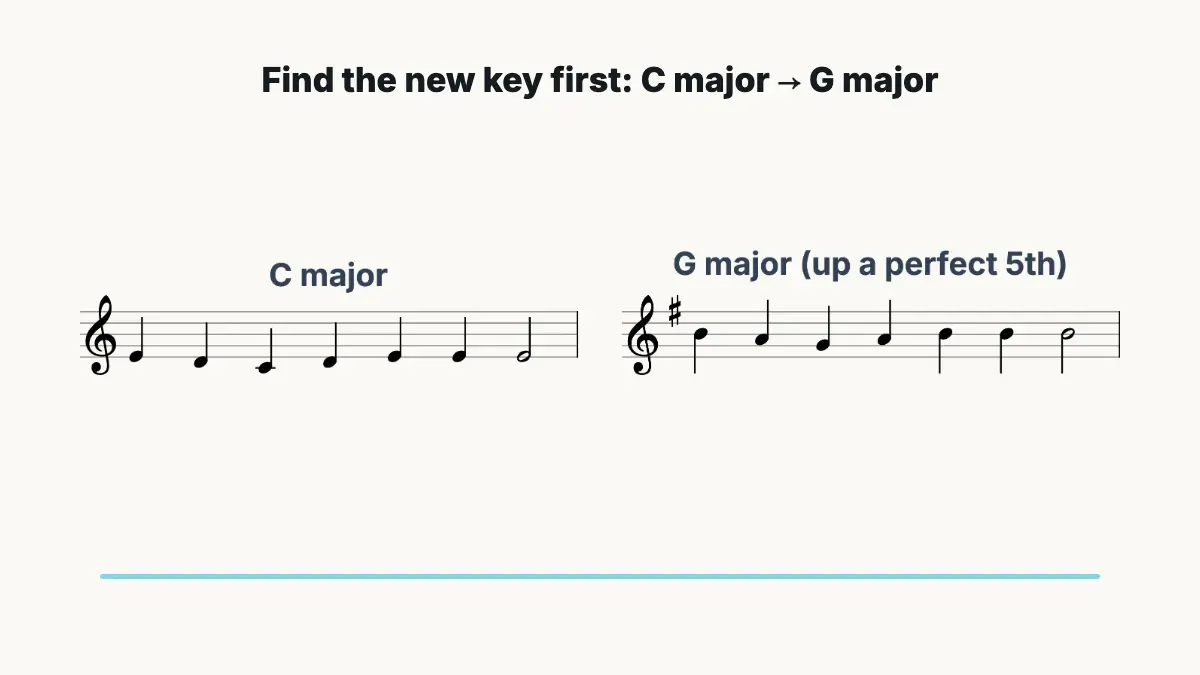
Most teachers find the key method faster for longer melodies. Move the tonic by the transposition interval to find the new key, write that key signature once at the start of the staff, and then move each note by the same number of letter names. The key signature supplies the sharps and flats.
For example, “Mary Had a Little Lamb” in C major moved up a perfect 5th becomes G major, with one sharp. Students write the F♯ in the key signature and never need to mark it on individual notes. Teach students to use single accidentals only where the original melody had them.
Move accidentals by the same interval
Notes outside the key must be transposed too, not copied. A phrase in C minor that ends with its raised leading tone, B♮ to C, moves up a major 2nd into D minor. The B♮ becomes C♯, the leading tone of D minor, because it moves by the same interval as every other note.
Have students circle every accidental in the original melody before they start. Each one becomes a checkpoint: after transposing, the new note should have the same relationship to the new key that the old note had to the old key.
Octaves and clefs
Moving a melody up or down an octave keeps every letter name and changes only the register. Rewriting music in another clef, such as copying a treble clef tune into bass clef for a cello or trombone, changes how the notes are written but not how they sound, unless you also move them by an octave.
When students rewrite a melody in a new clef, have them check the first and last notes against the clef before writing the rest. Use an 8va or 8vb mark only when the notes are left where they are and the performer is told to play them an octave higher or lower.
Written pitch and concert pitch in the band room
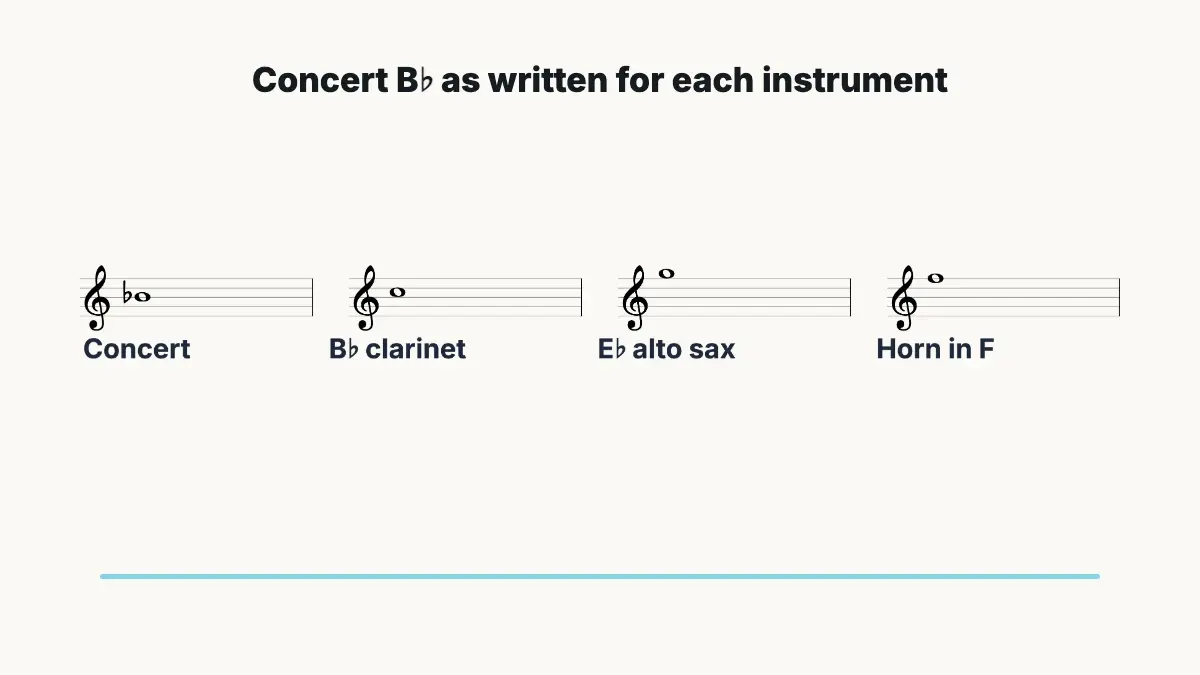
Many band instruments are transposing instruments: the note they read is not the note that sounds. A clarinet or trumpet in B♭ sounds a major 2nd lower than written, so its part is written a major 2nd higher than concert pitch. An alto saxophone in E♭ sounds a major 6th lower, and a horn in F sounds a perfect 5th lower. Trombone, euphonium, and tuba parts in bass clef are usually written at concert pitch.
The concert B♭ tuning note shows students why this matters. Clarinets and trumpets read it as C, alto saxophones read it as G, and horns read it as F, yet everyone plays the same sound. A piece in concert B♭ major therefore appears in C major for B♭ instruments, G major for E♭ instruments, and F major for horn.
Have each section transpose one short concert-pitch phrase into its own written key and then play it together. Hearing the parts line up turns an abstract rule into something students trust.
Common transposition mistakes
Students often move every note by the right number of letters but keep the old key signature, or copy accidentals instead of transposing them. Others transpose in the wrong direction for an instrument, writing a B♭ part a major 2nd lower instead of higher. Ask “written or sounding?” before every band transposition.
Spelling errors are the other big one. A transposition up a major 3rd from E is G♯, not A♭: the letter must move three letter names. Counting letters first and checking the semitones second prevents most of these.
A teaching order and practice plan
Start with short major-key melodies transposed up a 2nd, 4th, or 5th. Add the key-signature method once students can count letter names reliably, then melodies with accidentals, octave and clef changes, and finally written and concert pitch for the instruments your students play.
Use a fresh melody for each check so students practice the method, not one answer. The Transposition chapter of the Music Theory Teacher’s Book follows this same order, from recognizing a transposition to writing parts for B♭, E♭, and F instruments.