

Teaching guideKeys, scales & intervals
How to teach interval quality and inversions
Once students can count interval numbers, the next challenge is quality: is this third major or minor, and is that fourth perfect or augmented? This guide gives students one reliable method for naming the quality of any interval, adds augmented and diminished intervals, and then teaches interval inversions with the rule of 9. It builds on our general guide to teaching intervals and ends with printable interval practice and answer keys.
Check the two skills quality depends on
Interval quality rests on two earlier skills: counting the interval number from the lower note, and writing major scales. If students still miscount a sixth as a fifth, or hesitate over the notes of A major, spend more time there first. Quality work only goes smoothly when both are automatic.
Measure from the lower note’s major scale
Teach one method for every interval: imagine the major scale that starts on the lower note. If the upper note belongs to that scale, the interval is perfect for a unison, 4th, 5th, or octave, and major for a 2nd, 3rd, 6th, or 7th.
Work examples on the board. From E to G♯: G♯ is the 3rd note of E major, so it is a major 3rd. From B♭ up to E♭: E♭ is the 4th note of B♭ major, so it is a perfect 4th. Students only ever need to know one scale per interval, the scale of the lower note.
Make the rule about names explicit: unisons, 4ths, 5ths, and octaves are never called major, and 2nds, 3rds, 6ths, and 7ths are never called perfect.
Minor: one semitone smaller than major
If the upper note is one semitone lower than the note in the scale, a major interval becomes minor, with the same number. A to C is a minor 3rd, because the 3rd note of A major is C♯ and C is a semitone lower. E to D is a minor 7th, because the 7th of E major is D♯.
Emphasize that the letter names do not change. A 3rd is still a 3rd whether the top note is C or C♯; only the quality changes.
Augmented and diminished intervals
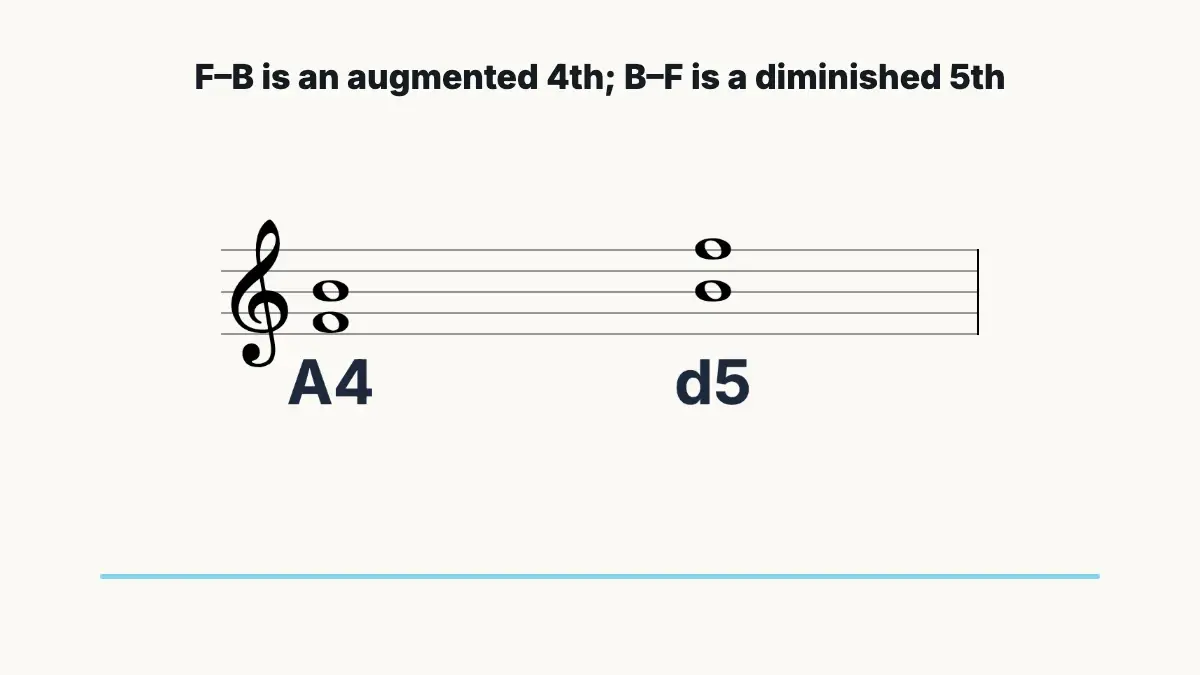
An augmented interval is one semitone wider than a perfect or major interval. F to B is an augmented 4th, because the 4th note of F major is B♭ and B is a semitone higher. A diminished interval is one semitone narrower than a perfect or minor interval. B to F is a diminished 5th, because the 5th note of B major is F♯.
The Music Theory Teacher’s Book uses a memorable diagram for this. Write the numbers 1 to 8 with their scale qualities underneath, P M M P P M M P. Put an A above every column, an m under every M, and a d under every P and every m. The result shows every quality in order of size, and students can redraw it from memory in a test.
Mention the tritone here. An augmented 4th and a diminished 5th both span six semitones, three whole tones, and sound the same, but they are spelled differently. The spelling, not the sound, decides the name.
Use semitone counts as a check
Counting semitones is a useful way to check an answer, not a replacement for the scale method. From the lower note: minor 2nd 1, major 2nd 2, minor 3rd 3, major 3rd 4, perfect 4th 5, tritone 6, perfect 5th 7, minor 6th 8, major 6th 9, minor 7th 10, major 7th 11, and octave 12.
Semitone counts alone cannot give the name, because different spellings share the same count. A minor 3rd and an augmented 2nd both span three semitones. Students should count the letter names first to get the number, then use the scale or the semitones to get the quality.
Invert intervals with the rule of 9
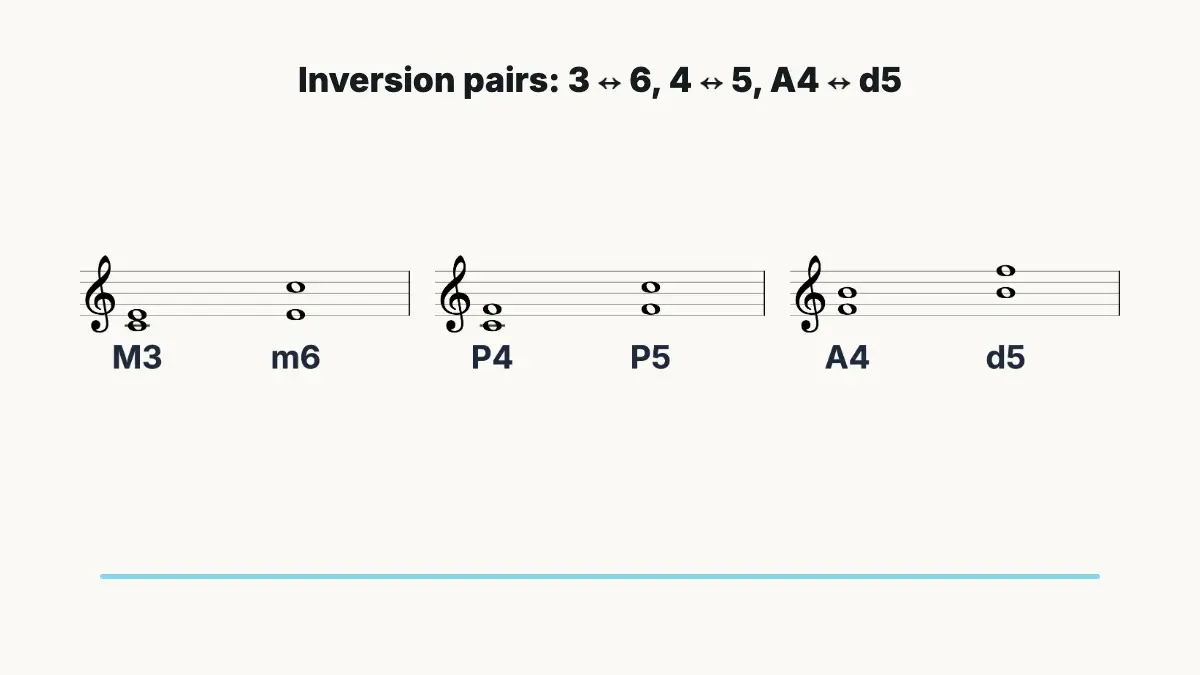
To invert an interval, move the lower note up an octave so it becomes the upper note, or move the upper note down an octave. C up to E becomes E up to C.
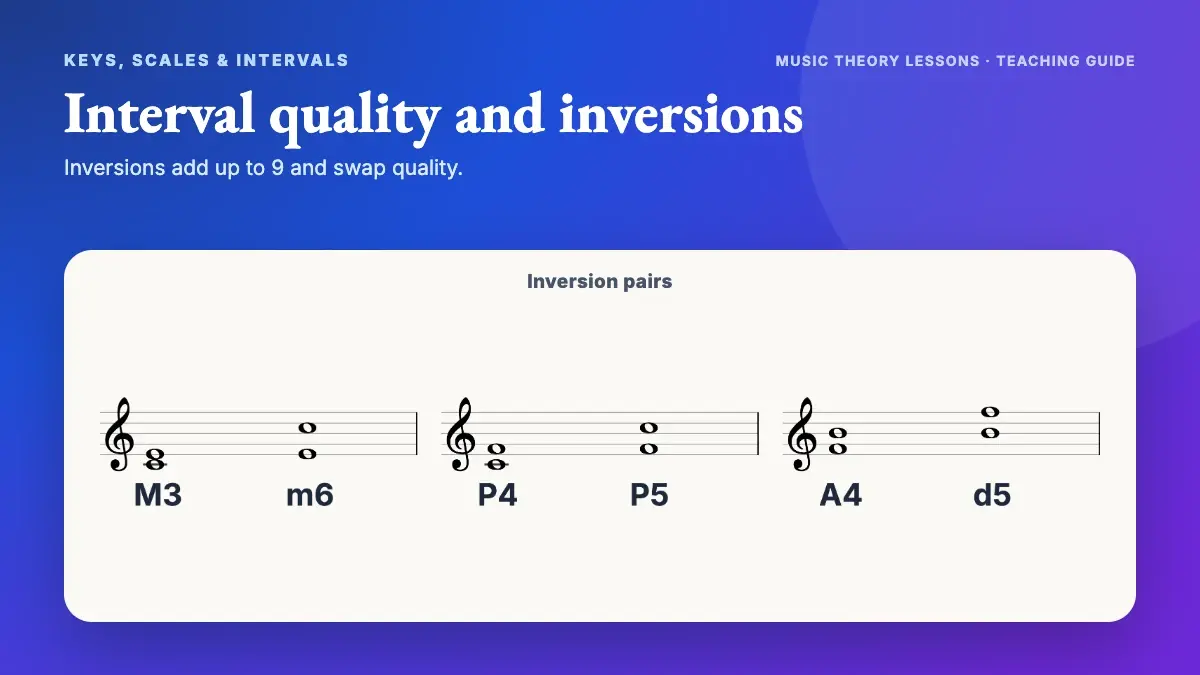
Two rules describe every inversion. The numbers add up to 9: a 2nd becomes a 7th, a 3rd a 6th, a 4th a 5th, and a unison an octave. And the qualities swap: major becomes minor, minor becomes major, augmented becomes diminished, and diminished becomes augmented. Perfect intervals stay perfect.
Work through pairs together. A perfect 4th inverts to a perfect 5th. A major 3rd inverts to a minor 6th. An augmented 4th inverts to a diminished 5th, which is why the tritone still spans six semitones when it is turned upside down.
Why inversions are worth teaching
Inversions give students a shortcut for wide intervals. To name C up to B♭, invert it: B♭ up to C is a major 2nd, so C up to B♭ is a minor 7th. Many students find small intervals much easier to name than large ones.
Inversion also prepares students for chord inversions, where the bass note changes but the chord stays the same. Keep the two ideas separate in class: an interval inversion turns one interval upside down, while a chord inversion changes which chord tone is in the bass.
Common interval mistakes
Students often measure from the upper note instead of the lower note, call a 4th or 5th major, or forget that the quality swaps when an interval is inverted. Have them circle the lower note before they start, and write the inversion rule at the top of every inversion worksheet until it is automatic.
Spelling is the other frequent problem: naming an augmented 4th as a diminished 5th because they sound the same. Ask students to count the letter names aloud before they choose a quality.
A one-week practice plan
Monday: the major scale method with perfect and major intervals. Wednesday: minor, augmented, and diminished intervals, with a quality worksheet as an exit ticket. Friday: the rule of 9 and an inversion worksheet that asks students to name both the interval and its inversion.
The Intervals chapter of the Music Theory Teacher’s Book covers the same sequence on the staff, ending with inversions, with answer keys for each page.