

Teaching guideClassroom & planning
Five-minute music theory warm-ups for the classroom
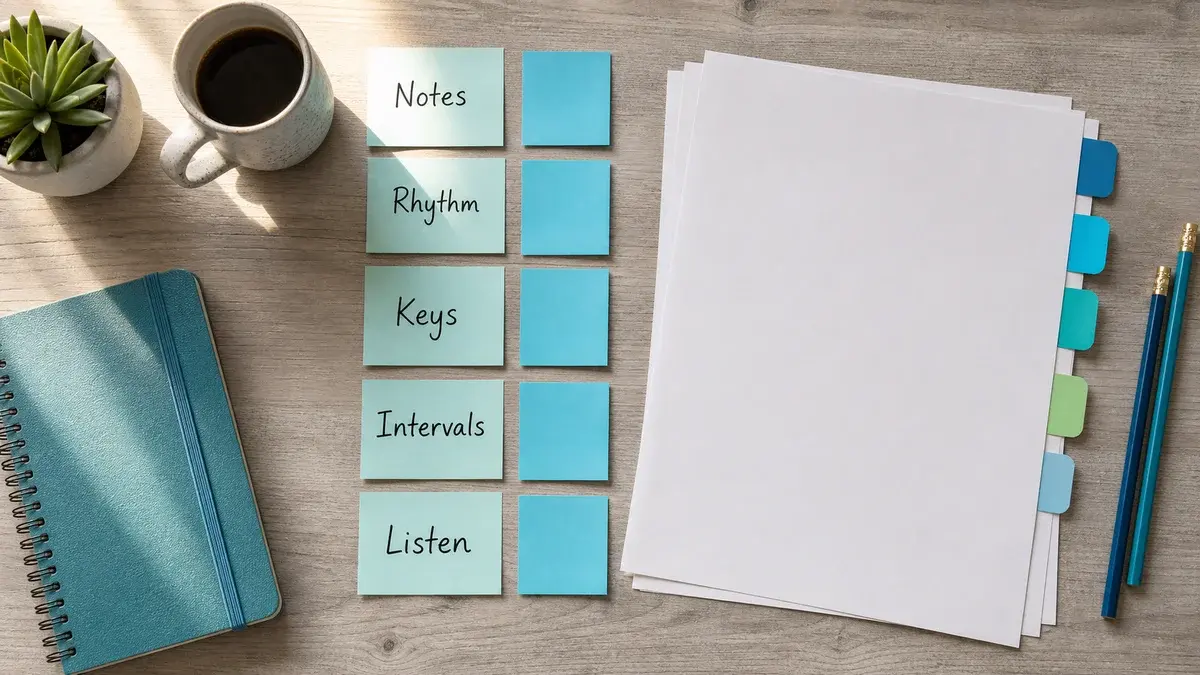
Short theory warm-ups at the start of class build literacy without stealing rehearsal time. Teachers in our community rotate a few predictable formats — note naming, rhythm echo, key identification, interval listening, and one-measure dictation — so students know what to expect while the examples stay fresh. This guide lays out a four-week rotation you can run in general music, band, choir, or private lessons, with links to generators that print a new page and answer key in seconds.
Why five minutes is enough
Warm-ups work when they are short, repeatable, and slightly different each week. Five to eight minutes at the bell gives students a predictable entry routine and lets you spot gaps before the main lesson starts.
Long theory packets at the end of a unit feel like a test; the same skills in a Monday drill feel like a game. Fresh worksheets matter — when the layout changes, students practice reading notation instead of memorizing where the G was on last month’s photocopy.
Band and choir directors often run warm-ups while students assemble instruments or find folders. General music teachers use them as a calm transition from homeroom. Private teachers open lessons with one printed line before repertoire.
Week 1: Note naming in one clef
Start with guide notes and neighbors in a single clef — treble for vocal and flute lines, bass for low brass, whichever matches the majority of your class that week.
Project five notes or pass a narrow note-naming worksheet. Students name aloud on a steady pulse, then pencil-check against the answer key you generated that morning.
Keep the range to eight or fewer pitches. Success builds confidence; a full-page marathon on Monday sets the wrong tone.
Week 2: Rhythm echo and counting
Clap or play a one-measure pattern in the meter your ensemble is rehearsing — 4/4 for most beginners, 3/4 when waltz repertoire appears.
Students echo twice, then notate a simpler version on a rhythm worksheet if literacy is ready. Match the note values to your counting system (ta-ti-ti, 1-and, or Kodály syllables) so classroom vocabulary stays consistent.
Generate three rhythm sheets at the start of the month with the same settings but different measures. You always have a backup warm-up without redesigning the lesson.
Week 3: Key signatures from repertoire
Pull keys from the music on the stand. Ask: major or minor? How many sharps or flats? Name the key before playing the scale.
A five-key identification warm-up in keys from program literature beats random keys from a theory book. Generate a key-signature worksheet with those keys pre-selected in Worksheet Studio.
When students confuse relative pairs (G major and E minor), pair identification with one scale degree question — “What is scale degree 1?” — before moving on.
Week 4: Intervals and listening
Melodic seconds and thirds on the piano or voice, then harmonic thirds and fifths if the class is ready. Students describe size before quality when quality is still shaky.
Swap in ear-training echo patterns for choirs — same interval, sung back. Band classes can use concert-pitch intervals on a keyboard.
End with one-measure rhythmic or melodic dictation only when note names and pulse are secure. Otherwise stay with echo-only listening.
Build a month-long rotation
Many teachers map Monday note naming, Tuesday rhythm, Wednesday keys, Thursday intervals or listening, and Friday a mixed “exit ticket” drawn from the week’s weakest skill.
You do not need five different lesson plans — you need five generator presets saved under names like “Monday treble warm-up” and “Wednesday concert keys.” Regenerate before class; settings stay, notes change.
After four weeks, repeat the rotation with wider ranges or new keys from upcoming concerts. Spiral review beats introducing a new skill every Monday.
Put it into practice this week
Sunday: generate one worksheet per warm-up day and print class sets plus one answer key.
Monday–Thursday: run the five-minute drill at the bell; log which two items confused the class.
Friday: assign a mixed sheet targeting those gaps, or share the teaching guide with colleagues who want the same rotation.