

Free interactive guide
The circle of fifths, explained
Sort the major scales by their sharps and flats, lay the cards out a perfect 5th apart, and the circle of fifths builds itself. Watch the order of sharps and flats appear, follow the animated story to all 15 key signatures, then use the interactive circle to find any key’s sharps or flats, its relative minor and its closest neighbours.
Part 1 · Sort the scales
Put the major scales in order and the pattern appears
The circle of fifths starts as a pile of scales. Sort them by how many sharps or flats they need and two things appear: the order of sharps and flats, and a chain of keys a 5th apart. Then lay the sorted cards out and they form the circle.
- B major5♯
- B
- C♯
- D♯
- E
- F♯
- G♯
- A♯
- B
- D major2♯
- D
- E
- F♯
- G
- A
- B
- C♯
- D
- C♯ major7♯
- C♯
- D♯
- E♯
- F♯
- G♯
- A♯
- B♯
- C♯
- C major0
- C
- D
- E
- F
- G
- A
- B
- C
- E major4♯
- E
- F♯
- G♯
- A
- B
- C♯
- D♯
- E
- G major1♯
- G
- A
- B
- C
- D
- E
- F♯
- G
- F♯ major6♯
- F♯
- G♯
- A♯
- B
- C♯
- D♯
- E♯
- F♯
- A major3♯
- A
- B
- C♯
- D
- E
- F♯
- G♯
- A
Part 2 · Place the scales on the circle
Lay the sorted scales out and watch the circle appear
Take the sorted cards one at a time, starting with C major. Each card is a perfect 5th above the one before, and when the line of cards runs out of room it bends into the circle of fifths. Scroll through the steps, use ← → on your keyboard, or open the presentation to project it for a class.
Step 1
Lay down the first card: C major
Every major scale follows the same pattern of tones and semitones: T–T–S–T–T–T–S.
Starting on C, that pattern lands on white keys only. C major needs no sharps and no flats, so its card goes first.
Step 2
The next card, G major, starts on the 5th note
The card with one sharp is G major. Count up C major to its 5th note: C, D, E, F, G. That is where G major starts.
To keep the T–T–S–T–T–T–S pattern, the 7th note must be raised: F becomes F♯. G major has one sharp.
Step 3
Two sharps: D major, a 5th above G
The card with two sharps is D major, and D is the 5th note of G major. Each card starts on the 5th note of the card before it.
It keeps F♯ and adds one new sharp, C♯. Notice where the new sharp falls: on the 7th note, the one just below the new key’s name.
Step 4
The pattern holds: A major
Up another 5th to A. Its scale keeps F♯ and C♯, and adds G♯ on the 7th note.
Each new key is a perfect 5th above the last, keeps every sharp from before, and adds exactly one more.
Step 5
E major, B major… the line runs off the page
E major adds D♯. B major adds A♯. Read the sharps in the order they arrived: F, C, G, D, A, E, B.
That is the order of sharps (Father Charles Goes Down And Ends Battles). Keep stepping up a 5th and the line soon runs out of room.
Step 6
Bend the line into a circle
There are only 12 different notes on the keyboard. Step up a perfect 5th 12 times and you land back where you started.
So the line bends into a circle. C sits at the top, and each clockwise step goes up a 5th and adds one sharp. F♯ major, with six sharps, sits at the very bottom.
Step 7
Now go the other way: F major
Step counterclockwise from C instead. That is down a perfect 5th, to F.
A major scale on F needs B♭ to fit the pattern. Counterclockwise keys use flats, and F major has one.
Step 8
Keep going: one more flat each time
Keep going down in 5ths. B♭ major adds E♭, E♭ major adds A♭, A♭ major adds D♭, and D♭ major adds G♭.
This time the new flat is the 4th note of each new scale. The flats arrive in the order B, E, A, D, G, C, F: the order of sharps read backwards.
Step 9
Where the two sides meet
At the bottom, the sharp side and the flat side overlap. F♯ major has 6 sharps. G♭ major has 6 flats. Play both scales and you press exactly the same piano keys.
Keys that sound the same but are spelled differently are called enharmonic keys. F♯ and G♭ share one spot on the circle.
Step 10
Seven sharps, seven flats: two more shared spots
Keep adding sharps past F♯ and you reach C♯ major, with all seven sharps. It sounds the same as D♭ major (5 flats).
Keep adding flats past G♭ and you reach C♭ major, with all seven flats. It sounds the same as B major (5 sharps). Three spots have two names, so the 12 positions hold all 15 major key signatures.
Step 11
The inner ring: relative minor keys
Every major key shares its key signature with a minor key that starts on its 6th note. A minor shares C major’s empty signature; E minor shares G major’s one sharp.
Write the relative minors inside the circle and the map is complete: 12 positions, every major and minor key, and the key signature each one uses.
C major
No sharps or flats
- CT
- DT
- ES
- FT
- GT
- AT
- BS
- C
Interactive circle of fifths
Pick any key to see its signature, scale and neighbours
G major
1 sharp: F♯
- GT
- AT
- BS
- CT
- DT
- ET
- F♯S
- G
- Relative minor
- E minor, same key signature
- One step clockwise
- D major: the V, or dominant, key
- One step counterclockwise
- C major: the IV, or subdominant, key
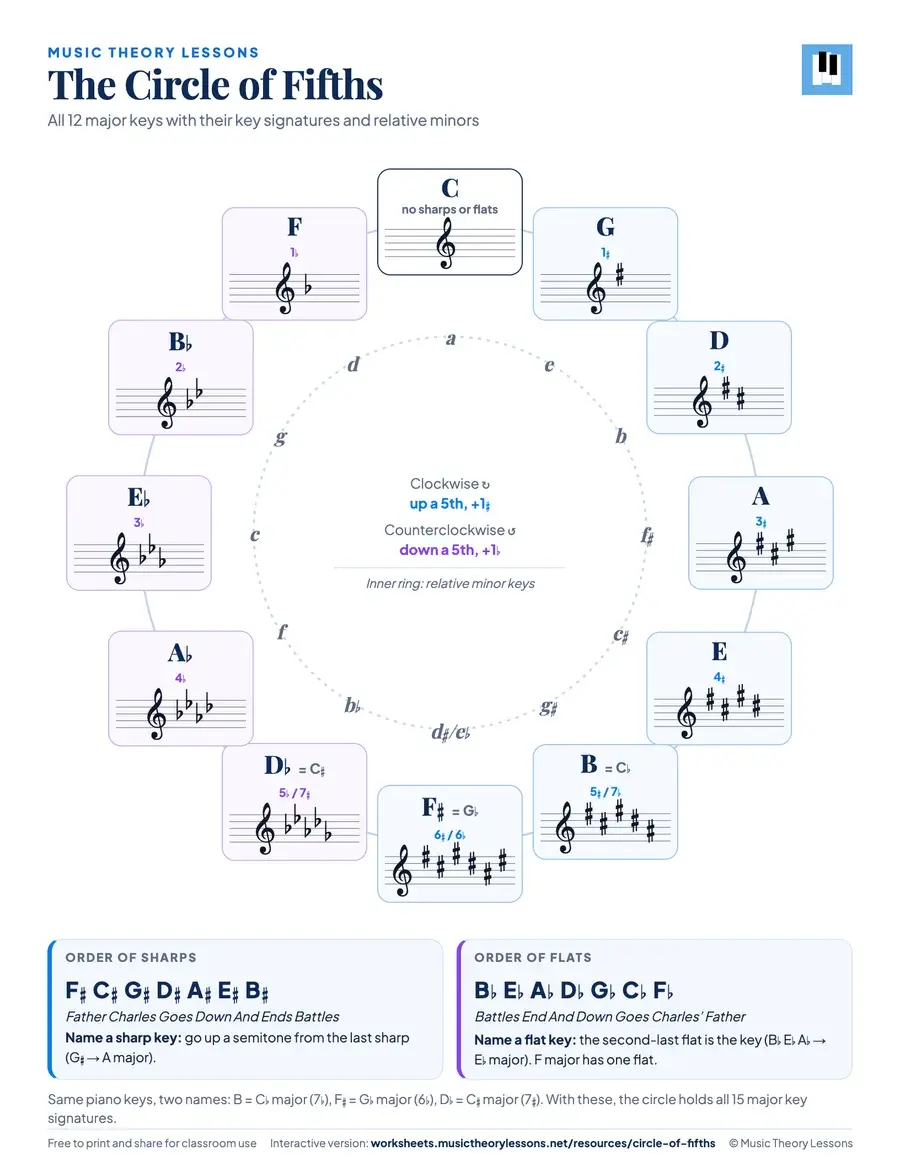
Free printable
Printable circle of fifths chart
A classroom chart with every key signature written on the staff, plus a fill-in version for students to complete. Free to print and share with your classes.
- Page 1: colour chart. All 12 major keys with their key signatures, relative minors, the order of sharps and flats, and how to name any key.
- Page 2: fill-in worksheet. Students write each key, its signature and its relative minor around the circle.
- Page 3: answer key.
How to read the circle of fifths
Start at C at the top. C major has no sharps or flats. Each step clockwise moves up a perfect 5th and adds one sharp: G (1♯), D (2♯), A (3♯), E (4♯), B (5♯) and F♯ (6♯). Each step counterclockwise moves down a perfect 5th and adds one flat: F (1♭), B♭ (2♭), E♭ (3♭), A♭ (4♭), D♭ (5♭) and G♭ (6♭).
The number of steps from C tells you how many sharps or flats a key has. At the bottom the two sides meet: F♯ and G♭ major are the same keys on the piano, spelled two ways. Counting the enharmonic spellings C♯ major (7 sharps) and C♭ major (7 flats), the circle holds all 15 major key signatures.
Relative minor keys on the circle
Every major key shares its key signature with a relative minor that starts on its 6th note, three semitones lower. On the circle, the minor keys sit on an inner ring: A minor inside C, E minor inside G, D minor inside F, and so on. A key signature on its own can mean either key; the music decides which, often through the raised 7th note of the minor key.
How to memorize the circle of fifths
- Rebuild it, don’t recite it. Write a major scale, find its 5th note, and start the next scale there. The circle reappears every time.
- Learn one mnemonic. Father Charles Goes Down And Ends Battles gives both the order of sharps and, read backwards, the order of flats.
- Use the clock.Number of sharps = the hour clockwise from C at 12 (G at 1 o’clock has 1 sharp). Flats count back from 12 the other way.
- Practise in short bursts. Name signatures and write them on the staff for a few minutes at a time with fresh examples.
Practise key signatures
This guide follows the Major Key Signatures chapter of our music theory textbook, where students build the circle from the major scales they have already written. Keep going with printable key-signature worksheets and answer keys.
Frequently asked questions
Why is it called the circle of fifths?
Each key on the circle is a perfect 5th above the key before it. There are only 12 different notes, so after 12 steps of a 5th you arrive back at the starting note, and the line of keys closes into a circle.
How do you use the circle of fifths to find a key signature?
Count the steps from C at the top. Each step clockwise adds one sharp and each step counterclockwise adds one flat. D is two steps clockwise, so D major has two sharps: F♯ and C♯.
What is the order of sharps and flats?
Sharps are added in the order F, C, G, D, A, E, B (Father Charles Goes Down And Ends Battles). Flats are added in the reverse order: B, E, A, D, G, C, F.
Where are the minor keys on the circle of fifths?
Each major key shares its key signature with a relative minor that starts on its 6th note. The relative minors are usually written on an inner ring: A minor inside C major, E minor inside G major, D minor inside F major.
Is there a printable circle of fifths chart?
Yes. The free PDF on this page has a colour classroom chart with every key signature written on the staff, a fill-in circle of fifths worksheet for students, and an answer key. No sign-up is needed.
What is the difference between the circle of fifths and the circle of fourths?
They are the same circle read in opposite directions. Clockwise each key is a 5th higher; counterclockwise each key is a 5th lower, which is the same as a 4th higher.